Sleeping on Water: The Story Behind Kashmir’s Houseboats — And Why You Need to Book One
By: JKL Travels – KashmirTravels | June 2026
Picture this. You wake up not to traffic or an alarm clock, but to the soft slap of water against carved wood, and the call of a shikara vendor selling fresh kahwa and saffron right outside your window. Above your bed, intricate wooden lattice patterns — centuries of craftsmanship — catch the first light of a Himalayan morning. You step out onto your private deck in a robe, and Dal Lake stretches out before you, the snow-capped Zabarwan range standing guard in the distance.
This isn’t a fantasy postcard. This is a regular Tuesday morning on a Kashmir houseboat.
If there’s one thing seasoned travellers agree on, it’s this: you haven’t really been to Kashmir until you’ve slept on it. Not beside the lake — on it. And once you understand the strange, almost accidental history of how these floating wooden palaces came to exist, the whole experience takes on a different kind of magic.
So, What Exactly Is a Kashmir Houseboat?
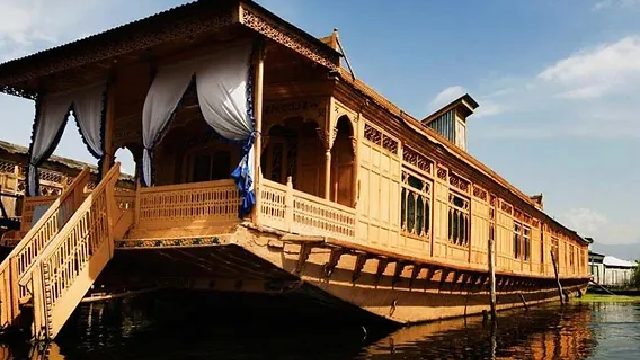
Think of it as a cross between a heritage cottage and a boat that decided to stay put. Built almost entirely from deodar wood — the local Himalayan cedar prized for shrugging off water damage for generations — these are not the rickety river shacks the word “houseboat” might bring to mind elsewhere. They’re proper homes. Carved ceilings. Walnut wood furniture. Hand-embroidered curtains. Sometimes even a small library of yellowing English novels left behind from another era entirely.
Most are around 60 to 100 feet long, with a deck out front, a cosy living room, a formal dining room, and two to four bedrooms — each with its own attached bathroom. Today, roughly 750 of them are still operating across Srinagar’s lakes, mostly clustered on Dal Lake and Nigeen Lake, with a smaller, increasingly rare handful still anchored along the Jhelum River.
And here’s the twist nobody expects: none of this was supposed to happen.
The Backstory Nobody Tells You: A Law That Accidentally Invented Romance
Rewind to the mid-1800s. Kashmir was under Dogra rule, governed under the terms of the 1846 Treaty of Amritsar, and there was a hard rule on the books — outsiders could not own land in the Valley. Full stop. No exceptions.
This was a perfectly reasonable policy for protecting local sovereignty. It was also a serious headache for the growing number of British officials and travellers who fell hopelessly in love with Kashmir’s summer scenery and had absolutely nowhere to legally call their own, even temporarily.
So they got creative. If land was off the table, water wasn’t governed by the same rule. A boat, after all, isn’t land. And so the British began commissioning elaborate wooden boats to live in — essentially using a legal technicality to build themselves summer homes that floated.
Local Kashmiri boatmen had already been using simple flat-bottomed doongas for fishing and transport along the Jhelum for generations — so the British didn’t invent the concept from scratch, they borrowed and elevated it. One British Army officer, General Denloff, is credited with sketching one of the very first proper houseboat designs after commissioning a boat he named “Mermaid,” complete with actual walls, windows, and a deck.
What happened next is the part that makes this story genuinely delightful: Kashmiri craftsmen took the idea and ran wild with it. Using deodar wood, artisans began carving elaborate ceiling panels using a nail-free technique called Khatamband, adding ornate wooden lattice screens known as Pinjrakari, and filling interiors with Victorian-style furniture fused with traditional Kashmiri textiles and carpets. The result was something genuinely new — part English countryside cottage, part Kashmiri art piece, entirely original. Owners gave their boats grand, slightly tongue-in-cheek English names — “New Crystal Palace,” “Houseboat Switzerland” — earning the whole fleet the affectionate nickname “a little piece of England afloat on Dal.”
One of the earliest fully documented houseboats, built in 1885, has its own charming origin story: a European visitor liked a Kashmiri craftsman’s converted boat-shop so much that he simply bought it on the spot — and a new local industry was effectively born overnight.
From Floating Camps to Permanent Address
The earliest houseboats actually moved. They were poled along the Jhelum, sometimes towed by horses along the riverbank when the current was strong, drifting from spot to spot like floating camps. But as more travellers arrived wanting longer, more comfortable stays, owners started anchoring their boats permanently in long rows along Dal and Nigeen Lake — and that’s essentially the setup you’ll find today.
After Independence in 1947, local Kashmiri families who had built and maintained these boats turned them into a thriving tourism business of their own, hosting travellers from across the world for weeks at a time through the 1960s, 70s, and 80s. It was, by most accounts, the golden era of the Kashmir houseboat.
A Tradition Under Strain
Here’s the honest part of the story that doesn’t always make it into the brochures. The insurgency of the late 1980s and 90s hit Kashmir’s tourism hard, and houseboats — entirely dependent on visitors — suffered badly. Many fell into disrepair. Some were simply abandoned.
The recovery since has been real but fragile. According to the J&K Houseboat Owners Association, the Valley once had somewhere between 1,500 and 2,000 houseboats at its peak. Today that number sits closer to 750. The Jhelum River has been hit hardest of all — down from over 200 houseboats to just 60 to 70 remaining. Security incidents, including the tragic Pahalgam attack in April 2025, have continued to trigger sudden waves of cancellations. And there’s a quieter crisis too: fewer and fewer young Kashmiri artisans are learning the painstaking Khatamband and Pinjrakari techniques that make these boats what they are.
So when you book a stay on one of these houseboats today, you’re doing something a little more meaningful than just picking a hotel room. You’re helping keep a genuinely endangered craft tradition — and the families behind it — afloat.
Choosing Your Lake: Dal, Nigeen, or the Jhelum?
This is the decision that shapes your entire stay, so let’s break it down honestly.
Dal Lake — If You Want the Full Spectacle
This is the Kashmir you’ve seen in every photograph. Floating vegetable markets at sunrise, the famous floating post office, shikaras in every shade of paint gliding past your window, and houseboats lined up like a wooden village on water. It’s busy, it’s beautiful, and it’s unapologetically the headline act of Kashmir tourism.
Stay here if you want easy access to candlelight dinners on deck, sunset shikara rides through the lily-covered channels, and proximity to the Mughal gardens and major Srinagar sights. This is the classic choice — and for first-timers, it’s hard to beat.
Nigeen Lake — If You Want the Quiet Version
A short distance away but a different world entirely. Nigeen — fittingly nicknamed the “Jewel Lake” — trades Dal’s bustle for genuine calm. Fewer boats, fewer crowds, and a sunset that hits the Zabarwan mountains in a way that feels almost private.
This is where couples go when they want the romance without the noise. If you’re celebrating something — an anniversary, a honeymoon, simply each other — Nigeen tends to feel like it was made for exactly that.
The Jhelum River — If Budget Matters Most
A handful of houseboats still sit along stretches of the Jhelum River running through Srinagar, offering a more rustic, riverside version of the experience at a noticeably lower price. Honestly, options here have shrunk considerably in recent years, so availability can be tight — but for travellers who want the authentic houseboat feeling without the Dal Lake price tag, this is your way in.
Two Sample Packages to Get You Started
Package One — The Romantic Dal Lake Escape
This is the one for honeymoons and anniversaries — the package built around moments, not just nights.
- Duration: 2 nights
- Houseboat grade: Deluxe
- Location: Dal Lake
- Includes: Private shikara ride, candlelight dinner on the deck, breakfast and dinner daily
- Tentative cost: ₹14,500 per couple (full package)
Picture a private shikara gliding you through the quieter backwaters at golden hour, followed by a candlelit dinner served right on your wooden deck as the lights of Srinagar begin to flicker on across the water. This is the version of Kashmir most people are dreaming of when they say “we should go for our anniversary.”
Package Two — The Budget Nigeen Retreat
For travellers who want the real experience without the premium price tag.
- Duration: 2 nights
- Houseboat grade: Standard
- Location: Nigeen Lake
- Includes: Shared shikara ride, breakfast and dinner daily
- Tentative cost: ₹9,750 per couple (full package)
You still get the carved cedar interiors, the lake at your doorstep, and the warmth of genuine Kashmiri hospitality — just without the extras stacking up the bill. A smart pick for couples, solo travellers, or small groups who’d rather spend their savings on the rest of the trip.
Worth noting: these figures are illustrative, based on standard 2026 market rates. Prices shift with season, houseboat grade, and add-ons like extra shikara rides or special Wazwan dinners. Always get written confirmation of the final tariff before you pay anything.
What You’ll Actually Pay — A Realistic Cost Guide
| Budget Tier | Per Night, Per Couple | What You’re Getting |
|---|---|---|
| Budget (Jhelum / standard Nigeen) | ₹1000–₹2000 | Simple, comfortable rooms; shared shikara |
| Mid-range (standard Dal / A-grade Nigeen) | ₹2,500–₹6,000 | Better finishes, attached bath, private shikara optional |
| Deluxe (premium Dal Lake) | ₹7,000–₹10,000 | Spacious heritage interiors, candlelight dinner options |
| Luxury (multi-room heritage boats) | ₹10,000–₹30,000+ | Full suites, premium dining, dedicated host service |
A few extras worth budgeting for: an additional shikara ride will run you ₹500–₹1,500, a special candlelight or anniversary dinner setup is usually ₹1,500–₹4,000, and if you’re visiting in winter, confirm whether heating is included or charged separately.
FAQ’s – Things People Always Ask Before Booking
1. Is it actually safe to stay on a houseboat? Yes. Licensed houseboats are registered and graded by J&K Tourism — just confirm registration before booking.
2. Will I have hot water and electricity? On any well-maintained, properly graded houseboat — absolutely. Many now offer Wi-Fi too.
3. Are meals included? Breakfast and dinner are usually part of the package. Candlelight dinners or Wazwan spreads tend to cost extra.
4. Dal Lake or Nigeen Lake — which should I choose? Dal for the classic, bustling Kashmir experience; Nigeen for quiet and privacy. Both are equally beautiful — it comes down to mood.
5. What’s the best time of year to go? April through October for ideal weather, with May–August being peak season. Winter stays are stunning if you’re prepared for the cold and confirm heating arrangements.
6. How do I find the cheapest houseboat options? Look at Nigeen Lake or the Jhelum River, and choose Standard grade over Deluxe — you’ll save significantly without losing the core experience.
7. How far in advance should I book? At least 3–4 weeks ahead during peak season (May–August); even more if you want a specific Dal Lake property.
8. Why were houseboats built in the first place? A 19th-century law barred outsiders from owning land in Kashmir, so the British started living on boats instead — and Kashmiri craftsmen turned the idea into an art form.
9. What wood are they made from? Deodar — Himalayan cedar — chosen specifically because it holds up well against constant exposure to water.
10. How many houseboats are left in Kashmir today? Around 750, down from an estimated 1,500–2,000 at the industry’s peak.
11. Do houseboats actually move, or are they permanently parked? Almost all are permanently moored today. Early houseboats were mobile, but the modern version is a fixed, stationary stay.
12. How big are they, really? Typically 60–100 feet long, with two to four bedrooms, a living room, dining room, and a front deck.
13. What’s Khatamband? A traditional Kashmiri ceiling technique where geometric wooden panels are fitted together without a single nail — a hallmark of premium houseboat interiors.
14. Is a houseboat good for a honeymoon? It’s genuinely one of India’s most romantic stay options — private, scenic, and steeped in craftsmanship and history.
15. Can a family or group book a houseboat? Yes — larger heritage boats can have up to 6–8 bedrooms, making them perfectly suited for families and groups, not just couples.
16. What does the grading system mean? Houseboats are graded Deluxe, then A, B, C, D — similar to a hotel star system, reflecting facilities and upkeep.
17. How long does it take to build one? A properly crafted houseboat, with detailed Khatamband and Pinjrakari work, can take skilled artisans up to two years.
18. Why have so many houseboats disappeared over the years? A mix of factors — the 1990s insurgency’s hit to tourism, ongoing security-related cancellations, ageing structures, and fewer artisans trained in the traditional craft.
19. Can I book directly with the houseboat owner instead of an agency? Yes, particularly off-season, and many houseboats are still family-run. Direct booking can mean better rates and a more personal experience.
20. What should I double-check before paying? Registration with J&K Tourism, recent guest reviews, exactly what’s included in the price (meals, shikara rides, heating), and written confirmation of the final cost.
So, Should You Book One?
Here’s the honest answer: yes, without hesitation. Not because it’s the “Instagram thing to do” in Kashmir, but because there genuinely is nothing else quite like falling asleep to the gentle creak of carved cedar against still water, in a room built by craftsmen who learned their trade from their fathers, who learned it from theirs.
A houseboat stay isn’t an add-on to your Kashmir trip. For a lot of travellers, it ends up being the whole point of it.
Whichever lake calls to you — the spectacle of Dal, the hush of Nigeen, or the rustic charm of the Jhelum — book early, ask the right questions, and let the water do what it’s done for travellers here for over 150 years.
Facts and history cross-checked against Daily Excelsior, Kashmir Observer, Atlas Obscura, CNN Travel and traditional craft documentation. Sample tariffs reflect standard 2026 market rates — confirm directly with operators before booking. Last updated: 27 June 2026.
