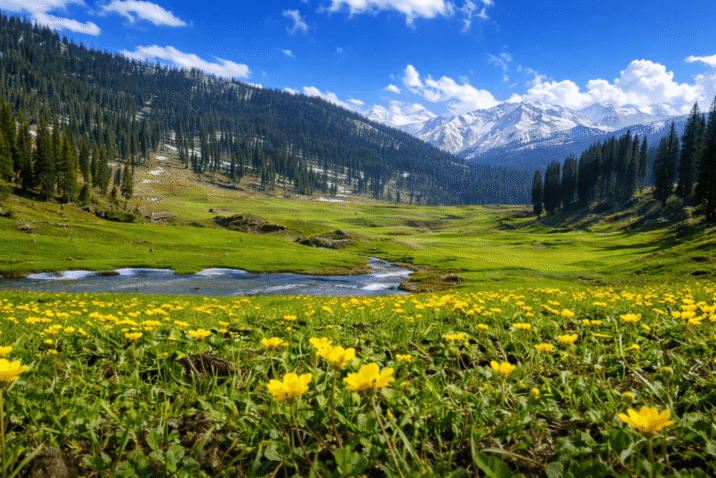
Kashmir’s Famous Gardens: The Ultimate Travel Guide
By: JKL Travels – KashmirTravels | July 2026
Ask anyone who’s stood in Nishat Bagh at sunrise, watching mist lift off Dal Lake while a row of chinar trees turns gold behind them, and they’ll tell you: photographs don’t do it justice. Kashmir’s gardens aren’t just sightseeing stops tacked onto a Kashmir itinerary — they’re the reason the valley earned its old nickname, “Paradise on Earth.”
These aren’t ordinary parks, either. They’re four-hundred-year-old feats of engineering, built by Mughal emperors who diverted mountain springs into cascading fountains without a single modern pump. Layer in Asia’s largest tulip bloom, centuries-old chinar groves that turn copper-gold every autumn, and hillside almond orchards that bloom pastel pink each spring — and you have a circuit that rewards travelers in every season, for entirely different reasons.
At JKL Travels, we’ve built and refined this garden circuit over dozens of Kashmir departures. Below is everything you need — verified history, a realistic day-wise itinerary, seasonal planning, and honest, current cost estimates — to plan yours.
The Mughal Gardens: Four Centuries of Living Architecture
Shalimar Bagh — The Abode of Love
Commissioned in 1619 by Emperor Jahangir for his beloved wife, Empress Nur Jahan, Shalimar Bagh is the grandest of Kashmir’s Mughal gardens — and it shows. A central water channel runs the length of four terraces, feeding fountain after fountain, flanked by towering chinars and black-and-gold Mughal pavilions that once hosted royal courts. Come at golden hour: the evening light-and-sound show, paired with the fading sun over Dal Lake, is worth building your whole afternoon around.
Nishat Bagh — The Garden of Joy
Designed in 1633 by Asif Khan, elder brother of Nur Jahan and father-in-law to Emperor Shah Jahan, Nishat Bagh is actually the larger of the two lakeside Mughal gardens — twelve sweeping terraces, said to represent the twelve signs of the zodiac, rising from the shore of Dal Lake toward the Zabarwan hills. Local guides still tell the story of Shah Jahan admiring the garden so openly that Asif Khan feared he’d be pressured to hand it over. Come for the terraces; stay for the view of the Pir Panjal range framed beyond the water.
Chashme Shahi — The Royal Spring
The smallest and most intimate of the three, built around 1632 during Shah Jahan’s reign, Chashme Shahi is built around a natural spring that locals still swear by for its cool, mineral-rich water. Three compact terraces make this an easy 30-minute add-on rather than a standalone visit — pair it with Shalimar and Nishat on the same morning.
Pari Mahal — The Palace of Fairies
Higher up the hillside, and older in feeling than any of the others, Pari Mahal was built by the Mughal prince Dara Shikoh in the mid-17th century as a school of astrology and Sufi learning. Today it survives as a seven-terraced garden in graceful ruin — arched doorways opening onto sky where a roof once stood. It has, without question, the best sunset view of Srinagar and Dal Lake on this entire list.
Modern & Seasonal Gardens: Kashmir in Full Bloom
Indira Gandhi Memorial Tulip Garden
Opened in 2007 at the foot of the Zabarwan hills, this is officially recognized as Asia’s largest tulip garden — roughly 1.5 million bulbs across dozens of varieties, planted in terraced beds with Dal Lake shimmering below. The catch: the bloom window is short, typically late March into mid-April, and the garden closes to the public once it fades. If your travel dates are flexible, build your entire trip around this window — it’s genuinely a once-a-year spectacle.
Naseem Bagh
Less a garden than a living monument, Naseem Bagh is a historic grove of centuries-old chinar trees that turns a deep, smouldering copper-gold every autumn. It sees a fraction of the footfall that Shalimar and Nishat do, which is precisely its charm — quiet, unhurried, and made for slow walks rather than checklist tourism.
Badamwari Garden
Tucked into Srinagar’s old city, Badamwari blooms with almond blossoms in early spring, turning the hillside a soft, pastel pink for a fleeting couple of weeks. It’s more a local secret than a tour-bus stop — worth the short detour if you’re in the city in March.
Beyond the City: The Offbeat Garden Trail
A short drive out of Srinagar unlocks a quieter side of this circuit. Verinag Garden is built around a deep natural spring — traditionally regarded as the source of the Jhelum River — with an octagonal Mughal-era stone basin at its centre. Achabal Garden, near Anantnag, is another Mughal-era layout of terraced lawns and fountains, calmer and far less crowded than the city gardens. And the Botanical Garden at the University of Kashmir offers a change of pace altogether — a research garden home to rare regional plant species, ideal for travelers who want their nature without the crowds.
Best Time to Visit: Season by Season
| Season | Months | What You’ll See | Crowd Level |
|---|---|---|---|
| Spring | March – May | Almond blossoms, tulips, cherry blossoms | High (peak season) |
| Summer | June – August | Full fountains, blooming roses, shaded chinar walks | High |
| Autumn | October – November | Copper-gold chinar foliage, cooler air | Low — best value season |
| Winter | December – February | Snow-dusted, near-empty pathways | Very low |
If forced to pick one season, spring wins for sheer variety of blooms. But autumn quietly offers the same gardens, the same views, at half the crowd and often better light for photography.
JKL Travels’ Detailed 3-Day Kashmir Garden Circuit
This route is sequenced by geography and daylight, not just a list — so you’re never doubling back across the city.
Day 1 — Srinagar’s Mughal Heritage (Approx. 6–7 hours of sightseeing)
- 8:30 AM — Depart hotel for Shalimar Bagh. Arrive early to enjoy the terraces before tour groups.
- 10:00 AM — Nishat Bagh for the lake and mountain views; allow 45–60 minutes.
- 11:15 AM — Chashme Shahi, a quick 30-minute stop for the spring.
- 12:00 PM — Lakeside lunch (Kashmiri Wazwan or a lighter café option near Boulevard Road).
- 2:00 PM — Optional Shikara ride on Dal Lake.
- 5:30 PM — Pari Mahal for sunset over Srinagar — arrive by 6 PM for the best light.
Day 2 — Seasonal & Scenic Gardens (Approx. 5–6 hours)
- 9:00 AM — Indira Gandhi Memorial Tulip Garden (in season, March–April) — go early to beat both crowds and the midday sun.
- 11:30 AM — Badamwari Garden (spring visits) for almond blossoms.
- 1:00 PM — Lunch in the old city.
- 3:00 PM — Naseem Bagh — a slow, unhurried chinar-grove walk, best in autumn light.
Day 3 — Outskirts & Offbeat Gems (Full day trip, approx. 7–8 hours including drive time)
- 8:00 AM — Depart Srinagar for Verinag Garden (roughly 2.5–3 hours’ drive via Anantnag).
- 11:30 AM — Achabal Garden, a short drive from Verinag.
- 1:30 PM — Lunch in Anantnag.
- 3:30 PM — Return drive to Srinagar.
- 6:00 PM — Botanical Garden, University of Kashmir, for a relaxed, green close to the circuit.
Tip: If you’re short on time, Day 3 can be trimmed to Verinag and Achabal only, saving 2–3 hours.
Tentative Costing: 3-Day Kashmir Garden Circuit
Figures below are per person, on twin-sharing/double-occupancy basis, for a 3-day / 2-night garden circuit including accommodation, private transport, entry fees, and a local guide. These are indicative 2026 estimates in INR — actual pricing varies by season (spring/summer peak vs. autumn/winter off-season), hotel availability, and current fuel and entry-fee rates. Please treat this as a planning estimate; JKL Travels will confirm exact costs at the time of booking.
| Component | 3-Star Package (per person) | 4-Star Package (per person) |
|---|---|---|
| Accommodation (2 nights, twin sharing) | ₹5,000 – ₹8,000 | ₹12,000 – ₹22,000 |
| Private cab (sedan/SUV, 3 days, driver + fuel) | ₹4,500 – ₹6,000 | ₹6,000 – ₹9,000 (SUV/premium car) |
| Garden entry fees (all sites, approx.) | ₹300 – ₹500 | ₹300 – ₹500 |
| Local guide (per day, shared across group) | ₹1,500 – ₹2,000/day | ₹2,500 – ₹3,500/day |
| Meals (breakfast included; lunch/dinner à la carte) | ₹1,500 – ₹2,500 | ₹2,500 – ₹4,000 |
| Estimated total per person | ₹13,000 – ₹18,000 | ₹22,000 – ₹35,000 |
Note: Tulip Garden season (late March–April) and peak summer (June–August) typically carry a 15–25% premium on hotel rates. Solo travelers and larger groups will see per-person costs shift accordingly, since cab and guide costs are shared. Houseboat stays on Dal Lake, a popular alternative to hotels, generally fall within or slightly above the 3-star range depending on the category.
Why Plan This Circuit With JKL Travels
Timing is everything here, and it’s the detail most generic itineraries get wrong. The Tulip Garden’s bloom lasts weeks, not months; chinar colour in Naseem Bagh shifts with how early or late autumn arrives that year; and hotel rates in Srinagar can swing by 25% or more between a Thursday and a Wednesday booking. Our Kashmir specialists track these windows locally, adjust itineraries in real time, and build costs around what’s actually available on your travel dates — not a generic calendar. Whether you want the full 3-day garden circuit, a condensed Mughal-gardens-only day, or these stops woven into a longer Kashmir trip with Gulmarg and Pahalgam, JKL Travels can tailor it end to end.
Frequently Asked Questions
Which Kashmir garden should I prioritize if I only have one day? Shalimar Bagh, Nishat Bagh, and Chashme Shahi sit close together and can comfortably be covered in a morning, with Pari Mahal added for sunset.
When does the Tulip Garden bloom, exactly? Typically late March through mid-April, though exact opening and closing dates shift each year depending on weather — always worth confirming closer to your travel dates.
Are the Mughal gardens open year-round? Yes, though winter hours are shorter and fountains are usually switched off outside the main spring-to-autumn season.
Is Pari Mahal worth visiting if it’s mostly ruins? Yes — it’s less about the structure and more about the view. Sunset from Pari Mahal over Dal Lake and Srinagar is one of the best in the city.
How much time should I set aside for the full garden circuit? Three days covers the circuit comfortably without rushing. It can be compressed into two days by dropping the outskirts (Verinag and Achabal), or stretched to four for a slower pace.
Do I need a guide, or can I visit these gardens independently? You can visit independently — entry is straightforward and signage is decent — but a local guide adds real value here, mainly through the history and folklore around each garden that isn’t posted anywhere on-site.
Are the gardens wheelchair or stroller accessible? The Mughal gardens have terraced levels connected by stone steps and slopes, so accessibility is partial rather than complete. The Tulip Garden and Botanical Garden are comparatively flatter and easier to navigate.
What’s the best combination of gardens for photography? Shalimar Bagh at golden hour, Nishat Bagh in the morning for reflections on Dal Lake, and Pari Mahal at sunset consistently produce the best results.
Is it safe to travel to Kashmir for tourism right now? Kashmir’s tourism circuit, including Srinagar’s gardens, Gulmarg, and Pahalgam, sees millions of domestic and international visitors annually and is well-serviced by hotels, guides, and transport. As with any destination, it’s worth checking current travel advisories closer to your travel dates, and JKL Travels can advise based on the latest ground conditions at the time of booking.
Can this garden circuit be combined with Gulmarg or Pahalgam? Absolutely — most JKL Travels Kashmir itineraries pair this 3-day garden circuit with 2–3 days each in Gulmarg and Pahalgam for a complete 7–8 day Kashmir experience.
Planning a Kashmir trip built around its gardens, lakes, and hill stations? JKL Travels designs custom itineraries around what’s actually in bloom when you travel, with transparent costing from day one. Get in touch to start planning your Kashmir garden circuit.
