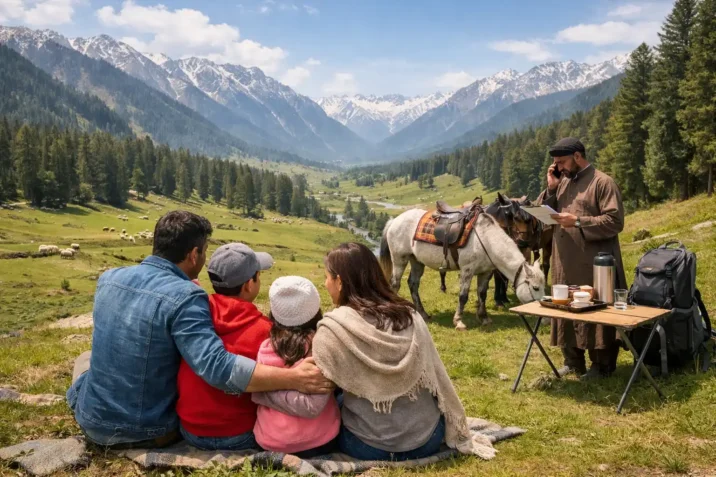
Kashmir Holiday Turns Into Nightmare After Family Books ‘Non-Existent’ Hotels Online: How to Avoid Travel Scams
By: Kashmir Travels – JKL Travels | September 2026
Beautiful Website, Millions of Followers—But Is Your Kashmir Booking Really Safe?
Srinagar: A Kashmir holiday planned around beautiful landscapes, comfortable hotels and carefully arranged sightseeing can quickly become a nightmare if the accommodation or travel service booked online turns out to be something very different from what was advertised.
A reported case involving a family travelling to Kashmir has once again raised an uncomfortable but important question for modern tourists: How do you know that the hotel, travel company or booking agent you are paying actually exists and is authorised to provide the service being sold?
According to the account provided, the family had planned its Kashmir vacation several weeks in advance and booked accommodation through an online platform. But after reaching the destination, they allegedly discovered that the hotels mentioned in their booking confirmation could not be located at the stated addresses. People in the surrounding area and nearby businesses reportedly had no knowledge of the properties.
The family was then left searching for alternative accommodation after arrival, reportedly facing additional expenses, lost time and considerable stress.
The specific circumstances of the reported case may require verification by the relevant authorities and booking platform. But the larger warning is highly relevant to anyone planning a Kashmir holiday—or indeed any trip booked online.
A website is not a licence. A verified-looking Instagram page is not registration. Millions of views are not proof of a genuine hotel booking. And a digitally generated confirmation document is not, by itself, proof that a room actually exists.
In an age when almost every part of a holiday can be booked with a few clicks, travellers need to understand one simple rule:
Verify the business behind the booking—not just the booking interface.
The New Travel Scam Is Not Always an Obviously Fake Website
Travel fraud has evolved.
The traditional image of a scam may involve a suspicious-looking website, poor grammar, a strange email address or an obviously unrealistic offer.
Today, things can be much more sophisticated.
A fraudulent or unreliable travel seller can potentially have:
- A professionally designed website
- High-quality photographs
- Attractive holiday packages
- WhatsApp business accounts
- Instagram and Facebook pages
- Thousands or even millions of views
- Large follower counts
- Customer testimonials
- Professionally designed invoices
- Booking confirmation PDFs
- Maps and location pins
- Online payment facilities
- Search-engine visibility
- Paid advertisements
- AI-generated promotional material
- Apparently genuine hotel photographs
None of these, individually, proves that the underlying transaction is legitimate.
That does not mean every large social-media account, website or online travel business is fraudulent. Far from it. Many genuine travel companies have invested heavily in websites, digital marketing and social media because that is simply how modern tourism works.
The point is different:
Digital appearance should be treated as marketing—not as legal or operational verification.
Even the Indian Cybercrime Coordination Centre’s reporting and awareness infrastructure recognises that suspicious websites, social-media URLs, phone numbers, email IDs and other digital identifiers can be used in cybercrime. Its suspect-reporting system allows citizens to report such identifiers, while warning that the database itself is based on complaints and is not a certification of guilt or authenticity.
In other words, don’t confuse digital popularity with due diligence.
Why Working Directly With a Properly Registered Local Travel Agent Can Make Sense
One of the strongest lessons from situations like this is the value of dealing with a genuine local travel professional whose business identity can actually be verified.
This does not mean travellers should blindly trust every local agent.
It means that instead of purchasing a complicated Kashmir itinerary from an anonymous online seller, a traveller can consider working directly with an established local operator and independently verify:
- Business registration
- Tourism-related registration or authorisation where applicable
- Physical office address
- GST/business details where applicable
- Official telephone numbers
- Company email domain
- Hotel booking arrangements
- Vehicle and driver arrangements
- Cancellation policy
- Payment account details
- Written itinerary
- Emergency contact
- Local representative
- Actual hotel confirmation
Jammu & Kashmir has an established regulatory framework for tourist trade, and J&K Police’s tourist-safety guidance specifically refers to the J&K Registration of Tourist Trade Act and the role of tourism authorities in addressing complaints involving cheating, overcharging, harassment, pestering and touting. The police also identify Tourist Police assistance at important tourist locations.
JKTDC, the government-owned Jammu & Kashmir Tourism Development Corporation, also maintains an agent-registration system on its official website, demonstrating that formal travel-agent relationships and registration mechanisms exist within the tourism ecosystem.
But there is an important distinction.
“Local” does not automatically mean “genuine.”
A local agent should still be verified.
The advantage of a legitimate local operator is that the traveller has a real business relationship to verify and, when problems arise, a local point of contact that can potentially intervene quickly.
That can be particularly valuable when a tourist is already in Srinagar, Gulmarg, Pahalgam or Sonamarg and something goes wrong.
A Local Office Can Matter More Than a Million Instagram Views
Imagine two travel sellers.
Seller A
Has:
- 2 million Instagram followers
- Millions of video views
- A beautiful website
- Drone footage of Kashmir
- Influencer collaborations
- Hundreds of screenshots of testimonials
But the traveller cannot independently establish:
- Where the business is physically located
- Who legally operates it
- Whether the person receiving payment is connected to the business
- Whether the advertised hotel has actually been booked
- Whether the phone number belongs to the company
- Whether the accommodation has confirmed the reservation
Seller B
Has:
- A modest website
- A smaller social-media presence
- A physical office
- Verifiable business details
- Proper registration where required
- A known local team
- A written itinerary
- Direct hotel confirmations
- Clear payment instructions
- A documented cancellation policy
- Someone who can actually meet the traveller at Srinagar Airport
For a holiday involving substantial advance payment, the second set of evidence is far more meaningful than follower counts alone.
Social media can tell you that an account has an audience.
It does not automatically tell you that the company behind it is authorised, solvent, responsible or capable of delivering your booking.
Every Digital Action Can Be Manipulated—So Verify the Real-World Transaction
This is perhaps the most important lesson for today’s traveller.
A computer can generate a document.
A website can display a room.
A social-media account can display a testimonial.
A map can show a pin.
A photograph can show a hotel.
A payment receipt can show a transaction.
But the question remains:
Does the real-world service exist?
Technology makes travel easier, but technology can also make deception look convincing.
A booking confirmation may contain a reservation number. That number should be independently checked with the actual hotel.
A hotel photograph may look authentic. The traveller should check whether the property has a consistent presence across reliable sources.
A location pin may appear on a map. The traveller should check whether the property actually operates there.
A travel company may advertise an extraordinary discount. The traveller should compare the offer with realistic market pricing and ask what exactly is included.
A person may send a QR code for payment. The traveller should establish who is receiving the money and why before transferring it.
The goal is not to become paranoid.
The goal is to become verification-minded.
Before Paying for a Kashmir Holiday, Verify These 12 Things
1. Verify the Travel Company
Ask for:
- Full legal/business name
- Office address
- Registration details
- GST details, where applicable
- Tourism registration or authorisation, where applicable
- Official company email
- Landline or established business contact
- Names of responsible representatives
Then independently verify the information.
Do not rely exclusively on documents supplied by the seller.
2. Check Whether the Office Actually Exists
This is particularly important when dealing with a local travel agent.
Ask for the physical office address.
Check it independently.
If practical, use map services, business directories, official tourism references or other reliable sources.
A genuine business should generally be able to explain where its office operates and how customers can contact it.
3. Contact the Hotel Directly
This is one of the easiest and most powerful checks.
Suppose an agent tells you:
“Your family has been booked at XYZ Hotel in Srinagar.”
Don’t stop there.
Call the hotel independently using contact details obtained from a reliable source rather than simply clicking the number supplied by the agent.
Ask:
- Is the property operating?
- Is the reservation in my name?
- What are my check-in and check-out dates?
- How many rooms are booked?
- What room category is confirmed?
- Has the booking been paid or guaranteed?
- Who made the reservation?
A genuine reservation should survive independent verification.
4. Don’t Treat Google Maps as Absolute Proof
Digital maps are useful—but they are not a legal certificate of existence.
A business can be newly established, incorrectly listed, relocated or represented inaccurately online.
So use maps as one verification layer, not the only verification layer.
Cross-check the location with:
- Hotel website
- Direct phone call
- Recent guest reviews
- Local travel operator
- Tourism references
- Recent photographs
- Actual address
If several independent sources point to the same property, confidence increases.
5. Examine Recent Reviews—Not Just the Rating
A 4.8-star rating can look impressive.
But don’t stop at the number.
Read recent reviews.
Look for repeated references to:
- Actual rooms
- Reception
- Location
- Check-in experience
- Staff
- Cleanliness
- Food
- Recent photographs
- Other identifiable details
Be cautious if hundreds of reviews appear generic, repetitive or unusually similar.
Also remember that reviews themselves are not infallible.
They are evidence—not proof.
6. Ask for the Exact Hotel, Not “Similar Accommodation”
One dangerous phrase in travel booking is:
“Hotel or similar.”
That wording can create confusion.
If accommodation matters to you, ask for:
Hotel name + complete address + room category + meal plan + confirmation status.
If the property is changed later, ask for the reason and obtain the replacement hotel’s details before accepting the change.
7. Never Let a Cheap Price Replace Verification
An unusually cheap Kashmir package can be tempting.
But ask what has been removed from the price.
Is the quoted price:
- Per person or per couple?
- Including taxes?
- Including meals?
- Including transport?
- Including sightseeing?
- Including tolls and parking?
- Including hotel upgrades?
- Including Shikara ride?
- Including Gondola tickets?
- Including entry fees?
- Including driver charges?
A low headline price can become expensive once exclusions are added.
More importantly, an exceptionally low price should trigger more verification, not less.
8. Pay the Right Business, Not Just the Right Person
Before making a bank transfer or digital payment, check the beneficiary.
If you are booking through a company, ask why payment is being requested into:
- A personal bank account
- An unrelated individual’s UPI
- A different company
- A third party
- A private wallet
There can be legitimate explanations in some transactions, but the relationship should be clearly explained and documented.
Keep:
- UTR number
- Payment receipt
- Invoice
- Bank details
- WhatsApp conversations
- Email correspondence
- Booking confirmation
J&K Police warns that fraudulent transactions and bogus companies are among recognised forms of cybercrime and advises caution around internet transactions and personal information.
9. Ask for a Proper Invoice
A professional booking should not depend entirely on a WhatsApp message saying:
“Confirmed sir.”
Request proper documentation.
The booking document should ideally identify:
- Business name
- Contact details
- Customer name
- Travel dates
- Number of travellers
- Hotel/property
- Room category
- Meal plan
- Transport details
- Package inclusions
- Exclusions
- Payment received
- Balance amount
- Cancellation terms
- Emergency contact
Documentation becomes especially important if a dispute occurs later.
10. Verify Before You Travel—Not After You Land
One of the worst times to discover a booking problem is at Srinagar Airport.
By then:
- Flights are already paid for.
- Children may be tired.
- Elderly travellers may need immediate accommodation.
- Peak-season rooms may be scarce.
- Prices may have increased.
- Alternative hotels may be expensive.
- Transport arrangements may already be underway.
Call the hotel 24–72 hours before arrival.
Confirm your reservation again.
Ask the hotel to confirm your name and dates.
If possible, obtain the confirmation in writing.
That five-minute call could prevent hours of trouble.
11. Beware of “Too Perfect” Digital Profiles
A travel company does not need millions of followers to be genuine.
Likewise, millions of followers do not guarantee that every transaction will be genuine.
Look beyond:
Followers → verification
and instead investigate:
Registration → business identity → physical presence → hotel confirmation → payment trail → customer support.
That is a much stronger chain of evidence.
12. Keep an Emergency Backup
Especially during:
- Christmas
- New Year
- Diwali
- summer holidays
- long weekends
- school vacations
- peak snowfall periods
keep a backup plan.
Save two or three alternative hotels in your destination area.
Keep the contact details offline.
If travelling with children or elderly family members, consider having a refundable or flexible first-night option where practical.
JKL Travels & Kashmir Travels: The Local-Operator Approach
For travellers who prefer to work directly with a Kashmir-based travel company, JKL Travels and Kashmir Travels position themselves as local travel operators serving Jammu & Kashmir, Ladakh and related destinations.
JKL Travels’ current website describes the company as a local travel agency and promotes direct, customised Kashmir packages, while its published contact information includes a Srinagar office address and direct telephone/email contacts.
Its current Kashmir listings include packages covering destinations such as Srinagar, Gulmarg, Pahalgam and Sonamarg, with hotel and houseboat options and private-vehicle arrangements on selected itineraries.
That is precisely the model travellers should look for generally: a real local business that can be independently contacted and whose arrangements can be verified before payment.
This is not an argument that a traveller should trust a company merely because it calls itself “local.” The same verification principles apply to every operator—including any operator mentioned in this article.
The rule is simple:
Verify first. Pay second. Travel third.
Planning Kashmir? Talk to a Local Team
If you are planning a Kashmir family holiday, honeymoon, group tour or customised itinerary, consider speaking directly with a Kashmir-based travel operator rather than relying entirely on anonymous online listings.
Explore Kashmir packages with JKL Travels
Ask for the exact hotel, exact itinerary, exact inclusions and written booking terms before making payment.
What Travellers Should Do If a Booking Turns Out to Be Fake
If you reach Kashmir and discover that your accommodation does not exist or your booking cannot be honoured, don’t immediately delete anything.
Preserve the evidence.
Take screenshots of:
- Website pages
- Booking confirmation
- Hotel listing
- Advertisements
- Instagram/Facebook profile
- WhatsApp conversations
- Emails
- Payment instructions
- Bank details
- UPI ID
- Phone numbers
- Location information
- Receipts
- Invoices
- Photos of the actual location
Also retain the original emails and payment records.
The Indian Cybercrime Coordination Centre advises complainants to preserve evidence such as payment receipts, bank statements, emails, URLs, chat transcripts, screenshots, videos and other relevant documents when reporting cybercrime.
Where to Report Online Travel Fraud in India
If you believe you have become a victim of an online scam or financial fraud, the National Cyber Crime Reporting Portal provides mechanisms for reporting cybercrime.
The portal also provides a facility for reporting suspicious website URLs, WhatsApp numbers, Telegram handles, phone numbers, email IDs and social-media URLs.
For financial cyber fraud, the national helpline is 1930.
Travellers should also consider contacting:
- The relevant booking platform
- Their bank/payment provider
- Local police
- J&K Police/Tourist Police where appropriate
- Tourism authorities
- Consumer grievance mechanisms, depending on the circumstances
J&K Police’s tourist-safety guidance specifically directs tourists facing cheating, overcharging, harassment or related problems toward tourism enforcement officials and Tourist Police assistance.
Don’t Confuse a Complaint With Proof of Fraud
There is another important side to the story.
A hotel reservation can fail for many reasons.
A property may:
- Change ownership
- Change its name
- Shut temporarily
- Relocate
- Stop accepting bookings
- Overbook
- Fail to update an online listing
- Have a dispute with a booking platform
- Experience a technical reservation problem
Therefore, travellers should distinguish between:
“My booking failed”
and
“The company deliberately created a fake booking.”
The second is a much more serious allegation and should be established through evidence and appropriate investigation.
The reported Kashmir incident should therefore be understood as a travel-safety warning, not as proof that every online booking platform or every travel company is unreliable.
Why Direct Local Coordination Can Be Especially Useful in Kashmir
Kashmir is not simply a hotel-and-flight destination.
A typical holiday may involve:
Airport → Srinagar → Gulmarg → Pahalgam → Sonamarg → Houseboat → Shikara → Local sightseeing → Return transfer
Weather, road conditions, hotel availability, local transport and seasonal demand can affect the practical execution of an itinerary.
A local operator can potentially coordinate changes more quickly because the team is physically connected to the destination.
For example:
If your flight is delayed
A local representative can coordinate the airport pickup.
If a hotel changes availability
The operator can communicate with the property and arrange an alternative.
If weather disrupts a sightseeing plan
The itinerary can be adjusted.
If a road journey is affected
A local team can advise on the practical alternatives.
If you have a problem after check-in
A local contact can potentially intervene much faster than an anonymous online seller operating hundreds or thousands of kilometres away.
This is one of the practical reasons many travellers prefer destination-based travel agencies.
Don’t Just Book Kashmir. Know Who Is Handling Your Trip.
Before paying for a Kashmir package, ask the operator one simple question:
“Who will be responsible for us after we land in Srinagar?”
If you are looking for a locally coordinated Kashmir itinerary, you can contact:
JKL Travels – Kashmir tour packages
Kashmir Travels – official travel portal
Whether you choose them or another operator, apply the same verification checklist: business identity, registration, hotel confirmation, written inclusions and traceable payment.
Website, Instagram or Booking Platform? What Should You Trust?
The answer is:
Don’t trust one signal. Build a chain of verification.
| What you see | What it tells you | What it does NOT prove |
|---|---|---|
| Beautiful website | Someone built a professional website | That every service is genuine |
| Large Instagram following | The account has an audience | That every booking is legitimate |
| Millions of video views | Content received substantial engagement | That the seller is registered |
| Five-star reviews | People have posted positive feedback | That every review is genuine |
| Google Maps listing | A digital location exists | That a hotel booking is confirmed |
| Booking PDF | A document has been issued | That the room exists |
| WhatsApp Business | A business profile is being used | That the company is authorised |
| Cheap package | The advertised price is low | That the package can actually be delivered |
| Online payment gateway | A payment mechanism exists | That the underlying service is genuine |
| Registered business | A formal business identity exists | That every transaction will be problem-free |
The strongest approach is to combine several independent checks.
A 10-Minute Pre-Booking Verification Test
Before transferring a significant amount of money, spend ten minutes checking:
✔ Business
Can you verify the company?
✔ Address
Does the physical office/location make sense?
✔ Registration
Can applicable registration details be independently verified?
✔ Hotel
Does the property actually exist?
✔ Phone
Does the hotel answer independently?
✔ Booking
Is your reservation confirmed directly?
✔ Payment
Who exactly receives your money?
✔ Documents
Do you have a proper invoice and itinerary?
✔ Cancellation
Are the refund conditions written down?
✔ Emergency
Who will answer if something goes wrong?
If the seller becomes irritated by reasonable verification questions, that itself is a reason to slow down.
A genuine travel professional should understand why a family wants certainty before spending its holiday budget.
The Biggest Mistake: Choosing a Travel Company Only Because It Looks Famous
Travel marketing is powerful.
Beautiful Kashmir photographs can make almost any package look irresistible.
A reel showing a houseboat at sunrise can generate millions of views.
An influencer can make a destination appear effortless.
A website can look like it belongs to a multinational travel company.
But tourism is ultimately delivered offline.
Someone must:
- Open the hotel door.
- Provide the room.
- Receive the guest.
- Arrange the vehicle.
- Provide the driver.
- Deliver the meals.
- Honour the itinerary.
- Answer the phone.
- Solve problems.
That is why the most important question is not:
“How popular is this travel company online?”
It is:
“Can I independently verify the people and businesses responsible for delivering my holiday?”
Local Does Not Mean Cheap—And Cheap Does Not Mean Safe
Another misconception is that booking directly with a local travel company must always be cheaper.
Sometimes it is.
Sometimes it isn’t.
The objective should not be to find the absolute lowest number on the internet.
The objective should be to find reasonable value with verifiable delivery.
A package that costs ₹2,000 less but leaves you without a room at midnight is not necessarily a bargain.
Similarly, a slightly higher quotation from a properly established operator may include:
- Better accommodation
- Private transport
- Local support
- Proper documentation
- Flexible coordination
- Emergency assistance
- Transparent inclusions
The cheapest quote should therefore be treated as a starting point for questions, not automatically as the best deal.
What a Responsible Kashmir Traveller Should Demand
Before confirming a package, ask for this information in writing:
1. Travel dates
2. Number of travellers
3. Hotel names
4. Complete hotel addresses
5. Room categories
6. Number of nights
7. Meal plan
8. Vehicle type
9. Sightseeing included
10. Activities included/excluded
11. Taxes and additional charges
12. Payment schedule
13. Cancellation/refund policy
14. Emergency contact
15. Local representative
16. Final invoice
Then independently verify the most important details.
Make Verification Part of Your Kashmir Planning
A Kashmir holiday should begin with excitement—not uncertainty.
If you want help planning a family holiday, honeymoon, group tour, houseboat stay or customised Kashmir itinerary, speak directly with a local travel team and ask for complete, written details before you pay.
JKL Travels – Local Kashmir travel packages
Kashmir Travels – Kashmir holiday planning
Don’t book because a package looks impressive online. Book after you have verified who is actually delivering it.
Five Red Flags That Should Make You Stop
🚩 1. “Pay immediately or the offer expires.”
Urgency can be legitimate during peak season, but pressure should never replace verification.
🚩 2. “Don’t call the hotel; we handle everything.”
There may be legitimate reasons for an agent to manage communication, but refusing reasonable independent confirmation deserves scrutiny.
🚩 3. “Our Instagram has millions of followers.”
That is not evidence of registration or booking validity.
🚩 4. “This is our personal UPI because the company account is unavailable.”
Ask for an explanation and proper documentation before paying.
🚩 5. “We’ll send the hotel details later.”
If accommodation is a major component of the package, you should know what you are paying for.
Five Green Flags Worth Looking For
🟢 1. A verifiable business identity
You know who you are dealing with.
🟢 2. A real local presence
There is an identifiable office/team or established destination operation.
🟢 3. Transparent documentation
The quotation, invoice and itinerary are clear.
🟢 4. Independent hotel confirmation
The property confirms your reservation.
🟢 5. Traceable payments
The recipient and transaction trail are clear.
No single green flag guarantees a problem-free trip—but together they create a much stronger basis for a booking decision.
Your Kashmir Holiday Deserves More Than a Pretty Booking Page
From Dal Lake houseboats and Shikara rides to Gulmarg, Pahalgam and Sonamarg, Kashmir offers enough experiences without adding unnecessary booking anxiety.
Work with a travel professional you can identify, verify and reach.
Plan your Kashmir journey with JKL Travels
Plan your Kashmir holiday with Kashmir Travels
Ask questions. Verify the property. Confirm the booking. Keep the documents. Then enjoy Kashmir.
Final Word: In Online Travel, Trust Must Be Verified
The reported family experience is a reminder of a problem that goes far beyond one hotel or one booking platform.
The internet has transformed tourism.
Today, a traveller sitting in Delhi, Mumbai, Bengaluru, Kochi or Ahmedabad can book a Kashmir holiday in minutes.
But convenience has created a new responsibility:
The traveller must learn to distinguish digital appearance from real-world verification.
A polished website is useful.
A large social-media audience is useful.
Good reviews are useful.
Online booking platforms are useful.
But none should replace basic due diligence.
For Kashmir, one practical approach is to consider working directly with a properly identifiable and appropriately registered local travel professional, independently verify the accommodation, insist on written terms, use traceable payments and retain every piece of documentation.
Because when the mountains are waiting, the last thing any family wants is to arrive in Srinagar carrying luggage, excitement and a booking confirmation—only to discover that the promised hotel cannot be found.
Your holiday should be remembered for the Dal Lake sunrise, the sound of a Shikara cutting through the water, the colours of the chinars and the mountains of Gulmarg—not for a frantic search for a room that was never there.
Frequently Asked Questions
Is it safer to book Kashmir directly with a local travel agent?
A properly identifiable and appropriately registered local travel agent can offer the practical advantage of having a destination-based team that can coordinate hotels, transport and itinerary changes locally. However, “local” alone is not a guarantee. Travellers should independently verify registration, business identity, accommodation and payment details.
Does a big Instagram following mean a travel company is genuine?
No. A large following demonstrates online reach or engagement, not necessarily legal registration, financial reliability or the validity of an individual booking.
Should I call the hotel after booking through an agent?
Yes. Independent confirmation is one of the simplest ways to establish that the property exists and that the reservation is recorded.
Is Google Maps enough to verify a hotel?
No. Maps are useful but should be combined with direct hotel contact, recent reviews, the hotel’s own information and other independent checks.
What documents should I keep after booking?
Keep the quotation, invoice, itinerary, payment receipt, UTR number, hotel confirmation, emails, WhatsApp conversations and screenshots of important booking information.
What if the hotel doesn’t exist when I arrive?
Document everything immediately. Contact the booking company and platform, preserve evidence and seek alternative accommodation if necessary. If you believe the incident involves cyber fraud or financial fraud, report it through the appropriate authorities. India’s National Cyber Crime Reporting Portal provides reporting mechanisms and the financial-fraud helpline is 1930.
Can I report a suspicious travel website before becoming a victim?
Yes. The National Cyber Crime Reporting Portal provides a facility for reporting suspicious website URLs, phone numbers, email IDs, WhatsApp/Telegram handles and social-media URLs.
Should I avoid online travel booking altogether?
No. Online booking can be convenient and legitimate. The lesson is to combine digital convenience with independent verification rather than assuming that a polished online presence automatically equals authenticity.
