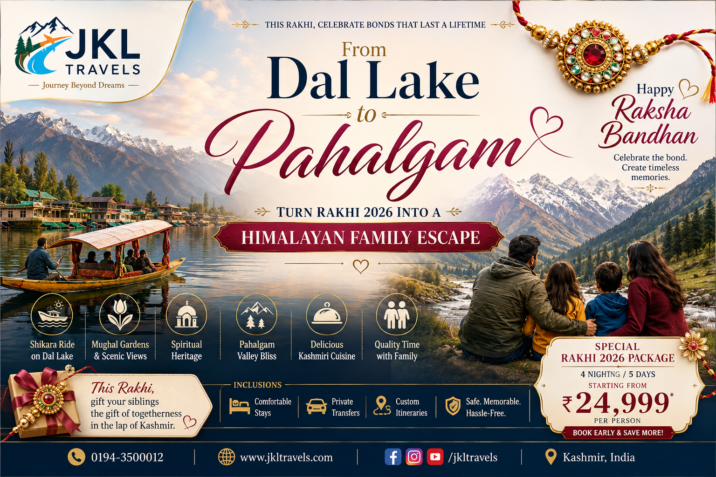
Beyond the Rakhi: Why Kashmir Could Be the Most Meaningful Family Getaway of 2026
By: JKL Travels – Kashmir Travels | August 2026
Raksha Bandhan 2026 is an opportunity to trade the familiar festival routine for mountain air, quiet lakes and a few unforgettable days together
There is something increasingly predictable about festival gifting.
A box of sweets. A watch. Perfume. Clothes. Perhaps an online voucher delivered minutes before the celebration.
But what if the best Raksha Bandhan gift is not something that can be wrapped?
What if it is a journey?
As families rethink how they celebrate important occasions, travel is emerging as a different kind of gift—one that is experienced together and remembered long after the photographs have been uploaded.
And for Raksha Bandhan 2026, Kashmir offers an unusually compelling setting.
The festival falls on Friday, August 28, giving families a natural opportunity to build a short getaway around the long-weekend period, depending on their work and school schedules.
Instead of celebrating for a few hours at home, siblings can spend several days exploring Srinagar, drifting across Dal Lake, driving through the valleys of Pahalgam, visiting Gulmarg or extending the journey towards Jammu and Ladakh.
The real attraction is not simply Kashmir’s scenery.
It is the chance to slow down together.
When a Rakhi Becomes a Reason to Travel
Raksha Bandhan has always been about relationships.
The ritual may take only a few minutes, but the emotion behind it is much larger: affection between siblings, family traditions and the reassurance that distance does not necessarily weaken a bond.
That makes travel an interesting extension of the festival.
A brother and sister who normally meet over hurried lunches can suddenly find themselves sitting together beside Dal Lake.
Parents who spend most of the year managing work and household responsibilities can finally enjoy an unhurried breakfast overlooking the mountains.
A family can turn the annual Rakhi gathering into a story that begins with a sacred thread and ends several days later with a suitcase full of photographs.
That is the appeal of experiential gifting.
And Kashmir is almost tailor-made for it.
Kashmir Is More Than a Destination—It Is a Shared Experience
The conventional Kashmir itinerary is familiar: Srinagar, Gulmarg and Pahalgam.
But the destination becomes more interesting when travellers stop treating those places as boxes to tick.
Srinagar is about water, architecture, gardens, food and old-city culture.
Gulmarg is about open landscapes and mountain views.
Pahalgam is about rivers, forests and slower days.
A houseboat on Dal Lake adds another dimension entirely.
For a family holiday, that variety matters.
Not everyone wants an adventure trip. Not everyone wants luxury. Not everyone wants to spend six hours every day inside a vehicle.
Kashmir allows a group to mix experiences.
One day can be leisurely.
The next can be outdoors.
Another can be devoted to shopping, food and local culture.
That flexibility is one of the strongest arguments for choosing the Valley for a multi-generational family holiday.
Dal Lake at Sunrise: Where the Holiday Really Begins
For many first-time visitors, Dal Lake is the image they have already seen a thousand times.
The shikaras.
The mountains.
The houseboats.
The reflections on the water.
Yet seeing it in person is different.
Early morning on Dal Lake has a quietness that is difficult to reproduce in a photograph. Shikaras move gently across the water while the surrounding landscape gradually brightens.
For siblings travelling together, a morning shikara ride can become one of those small experiences that ends up defining the entire trip.
There is no complicated activity involved.
Just water, mountains and time.
And that is precisely why it works.
The Houseboat Question: Luxury or Experience?
A houseboat stay is often marketed as the quintessential Kashmir experience—and for good reason.
But travellers should distinguish between the idea of a houseboat holiday and the specific property they are booking.
Room quality, location, meals, furnishings and services can vary considerably.
Anyone booking a houseboat as part of a Raksha Bandhan package should therefore ask for the property name and room category rather than accepting a generic description.
For families, one carefully selected night on Dal Lake can be enough.
There is no need to spend the entire holiday on a houseboat.
The combination of a conventional hotel stay with one night on Dal Lake can offer a better balance between comfort and experience.
Gulmarg in August: Beautiful, But Don’t Expect a Winter Wonderland
There is another misconception worth clearing up before families book their Raksha Bandhan holiday.
August is not Gulmarg’s peak snow season.
The landscape at this time of year is generally associated with greener mountain scenery rather than the snow-covered slopes seen in winter.
That does not make Gulmarg less attractive.
In fact, travellers looking for a relaxed summer mountain escape may prefer the warmer-season landscape.
The important thing is to book according to reality, not an old winter photograph.
JKL Travels’ current Kashmir material separately highlights summer and winter experiences, with skiing and snow activities associated with the winter season.
For Raksha Bandhan travellers, Gulmarg is better approached as a mountain-and-meadow experience.
Pahalgam Is Where Families Can Finally Slow Down
If Srinagar is the cultural heart of the trip and Gulmarg supplies the mountain drama, Pahalgam brings the pace down.
The Lidder River, surrounding hills and nearby valleys create an environment suited to travellers who do not want every hour planned.
That makes Pahalgam particularly attractive for families.
Instead of chasing attractions from morning until evening, visitors can take walks, photograph the scenery, enjoy local food and simply sit together.
It is an important lesson in modern travel:
The most memorable part of a holiday is sometimes the part where nothing happens.
What Does a Kashmir Holiday Actually Cost?
This is where travellers need to look beyond advertising headlines.
JKL Travels currently lists multiple Kashmir products, including a six-day Kashmir Calling itinerary and a five-day Honeymoon in Kashmir package, with published prices varying according to the package. Its current site also features Kashmir-with-Katra and Kashmir-Ladakh itineraries.
The supplied Raksha Bandhan offer includes a ₹9,499-per-person starting option and a ₹25,000-per-couple 4N/5D proposition.
Those figures should be treated as promotional starting points rather than universal final prices.
Why?
Because the cost of a Kashmir holiday depends on:
- Travel dates
- Hotel category
- Number of travellers
- Vehicle type
- Meal plan
- Room occupancy
- Sightseeing
- Activities
- Houseboat category
- Transfers
- Optional attractions
A family should therefore ask one simple question before booking:
“What exactly is included in this price?”
That question is often more useful than asking whether the package is cheap.
Budget Travel Doesn’t Have to Mean Compromising on the Experience
The word “budget” is sometimes misunderstood.
A budget holiday does not necessarily mean poor accommodation or an uncomfortable journey.
It can simply mean spending selectively.
For example, travellers may choose a comfortable mid-range hotel but spend less on luxury dining. They may take one premium experience—such as a houseboat stay—while keeping the rest of the itinerary practical.
That approach often produces a better holiday than trying to make every component premium.
JKL Travels currently positions its Kashmir portfolio across different traveller categories and price points, including family, honeymoon, pilgrimage and adventure travel.
The key is matching the package to the traveller rather than chasing a generic “best package”.
A 4-Night Kashmir Escape Can Be Enough
Not every family has a week to spare.
For working professionals, students and parents, a four-night itinerary can offer a useful compromise.
A possible structure is:
Day 1 — Srinagar
Arrival, hotel check-in, Dal Lake or Mughal gardens.
Day 2 — Gulmarg
Mountain scenery, local sightseeing and optional activities subject to operating conditions.
Day 3 — Pahalgam
Valley landscapes, riverside views and a slower day.
Day 4 — Srinagar
Shopping, heritage sightseeing, local food and a final Dal Lake experience.
Day 5 — Departure
Airport transfer and return home.
The exact routing should be adjusted around flight schedules and local conditions.
The important thing is not how many destinations appear on the itinerary.
It is whether the family has enough time to enjoy them.
And Then There Is Jammu
For families who want the journey to include a spiritual element, Jammu provides another option.
A Kashmir holiday can be combined with a visit to Katra and the Vaishno Devi shrine, creating a journey that mixes pilgrimage with leisure.
JKL Travels currently lists Kashmir-with-Katra packages among its offerings.
This combination can work particularly well for extended families because it allows different generations to participate in different parts of the trip.
But pilgrimage travel requires planning.
Travellers should consider walking requirements, registration procedures, weather, crowd levels and the physical fitness of older family members before committing to a tight itinerary.
For the Adventurous Sibling: Take the Journey to Ladakh
Every family has that one sibling who thinks a holiday should involve a little dust, altitude and adventure.
For them, Ladakh changes the equation completely.
The landscape beyond Kashmir is stark and dramatic: high mountain passes, monasteries, barren valleys and the deep blue expanse of Pangong Lake.
JKL Travels currently promotes combined Kashmir-Ladakh journeys alongside standalone Ladakh experiences.
But Ladakh demands more respect than a conventional sightseeing destination.
Altitude acclimatisation is important. Road journeys can be long. Weather can change rapidly, and travellers should allow contingency time.
For a family, the best Ladakh itinerary is rarely the most ambitious one.
It is the one everyone can comfortably complete.
The Smart Traveller’s Checklist Before Paying for a Package
A beautiful brochure is not enough.
Before booking a Raksha Bandhan holiday, ask the operator for a written itinerary covering:
Accommodation:
What are the actual hotel and houseboat names?
Transport:
Is the vehicle private or shared?
Meals:
Does the price include breakfast, dinner or both?
Activities:
Are Gondola rides, pony rides or other activities included?
Sightseeing:
Which destinations are covered?
Taxes:
Are taxes already included?
Cancellation:
What happens if the trip has to be postponed?
Weather:
What happens if road conditions affect the itinerary?
Payment:
Is the payment being made to the legitimate travel company?
These questions take minutes to ask and can prevent significant confusion later.
Why Local Expertise Can Make a Difference
Kashmir is not a destination where every itinerary can be treated like a fixed spreadsheet.
Driving times change. Weather changes. Attractions can become temporarily inaccessible. Local restrictions or operational conditions can affect plans.
A local operator can therefore be useful when a traveller needs on-ground coordination.
JKL Travels identifies itself as a Srinagar-based travel and event company and publishes a Srinagar office address and contact details on its current website.
Its current package material also explicitly notes that some activities and certain local sightseeing arrangements may not be included in advertised package prices.
That detail is important.
A professional traveller does not simply ask, “How much is the package?”
They ask, “What happens after I book it?”
The Bigger Trend: Travel Is Becoming the Gift
Perhaps the most interesting part of the Raksha Bandhan travel story is not Kashmir itself.
It is the changing idea of what constitutes a meaningful gift.
Younger families increasingly have access to things that previous generations considered luxuries. Gadgets, clothing and online shopping are convenient, but they can also become forgettable.
A journey is different.
A sibling may forget which watch they received in 2026.
They are less likely to forget watching the sun rise over Dal Lake with their family.
They may not remember the restaurant bill.
They will remember the road to Pahalgam.
They may not remember the packaging of a Rakhi gift.
They will remember the photographs taken together in Kashmir.
That is why experiential gifting has such emotional power.
A Different Kind of Rakhi Celebration
The most interesting Raksha Bandhan trips do not try to escape the festival.
They carry it with them.
Tie the Rakhi in the hotel room.
Celebrate over breakfast.
Take a family photograph beside Dal Lake.
Share kahwa after the ceremony.
Then spend the afternoon exploring Srinagar.
The ritual remains the centre of the day.
The destination simply gives it a new backdrop.
What JKL Travels Brings to the Picture
For travellers considering a professionally arranged holiday, JKL Travels’ current portfolio spans leisure travel, family holidays, honeymoon packages, pilgrimage journeys and Kashmir-Ladakh itineraries.
Its current website lists contact details including +91 88033 24 365 and sales@jkltravels.com, with a Srinagar office address on Residency Road.
The company can therefore be considered by travellers who prefer a locally coordinated itinerary rather than assembling every hotel, transfer and sightseeing component independently.
As always, travellers should verify the latest price, availability, hotel, inclusions and cancellation conditions before making a booking.
This Rakhi, Don’t Just Exchange Gifts. Make a Memory.
There is nothing wrong with traditional Raksha Bandhan gifts.
But there is something special about choosing an experience instead.
A few days in Kashmir can bring siblings out of their normal routines and place them in a landscape where conversation comes easier, mornings feel slower and even an ordinary cup of tea becomes part of the memory.
That is perhaps the strongest argument for a Raksha Bandhan holiday.
Not luxury.
Not status.
Not even the destination itself.
Time together.
And in a world where time is often the hardest thing to give, that may be the most meaningful gift of all.
