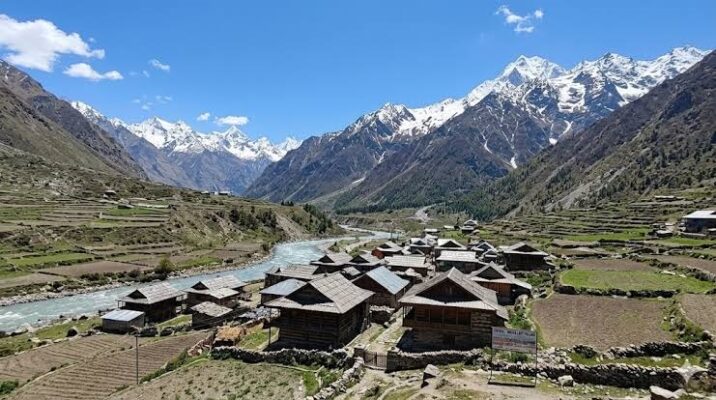
Life On The Line: A Journey Through India’s Most Extraordinary Border Villages
By: JKL Travels – Kashmir Travels | July 2026
Where a river becomes a border, a village gets rebranded from “last” to “first,” and soldiers have shaken hands at sunset every day since 1959 — a deep look at the extraordinary, ordinary lives being lived at the edge of the map.
There is a particular kind of silence that exists only at a border. Not the silence of emptiness — the villages here are full of life, dogs barking, children walking home from school, the clang of a kitchen somewhere close by — but the silence of proximity. The silence of knowing that a few hundred metres away, across a river or a fence or a line drawn on a 1947 map, an entirely different country is going about its evening in exactly the same way.
North India holds more of these silences than almost anywhere else on Earth. Along a jagged corridor stretching from the pine forests of Kashmir to the salt flats of the Thar Desert, five very different frontiers — five different climates, cultures, and histories — sit within touching distance of Pakistan, China, and each other. These are not war zones frozen in time. They are villages. People are born here, marry here, grow apricots and wheat and pashmina wool here, and increasingly, welcome curious travellers who want to understand what it actually means to live on a line.
This is a journey through five of them.
Kashmir: Where The River Is The Border
Drive north from Srinagar, past the last checkpoint that still feels like “regular” Kashmir, and the landscape begins to fold in on itself — steeper, quieter, greener. This is the road to Gurez, a valley so visually overwhelming that it’s almost disorienting to remember it sits just kilometres from one of the most militarised borders on the planet.
For decades, Gurez, along with the neighbouring villages of Keran, Tangdhar, and Karnah, existed largely outside the Indian tourist imagination — known, if at all, for their proximity to conflict rather than their extraordinary beauty. That has changed dramatically. These once-guarded frontier regions are now drawing thousands of visitors a day during peak season, a shift that says as much about changing security dynamics as it does about the growing appetite for places that still feel genuinely undiscovered.
What makes Gurez remarkable isn’t just the scenery — though the meadows beneath Habba Khatoon peak, named for a 16th-century Kashmiri poetess-queen, are the kind of green that photographs never quite capture. It’s the texture of daily life. In the village of Dawar, the Indian Army runs a small café staffed by trained locals, a rare, almost tender collaboration between military presence and civilian livelihood. Wooden houses with sloped roofs — built to shrug off heavy Himalayan snow — line the Kishanganga River, which flows down from these mountains into Pakistan-administered Kashmir, where it becomes known as the Neelum.
Further along, at Keran, the border stops being an abstraction entirely. The Kishanganga River itself forms the international boundary here, meaning villagers on the Indian side can look directly across the water at homes, fields, and lives unfolding on the other side. There is no fence, no wall — just a river, and the strange, quiet intimacy of watching a foreign country from your own front porch.
And then there’s Tangdhar, a village that seems designed by geography to make a point. Surrounded on three sides by Pakistan-administered Azad Kashmir, it sits at the end of the dramatic Sadhna Pass road, a place where India narrows almost to a single thread before opening out again. Locals here speak of decades when the outside world simply didn’t come — and of the strange, still-unfamiliar experience of tourists arriving with cameras instead of convoys.
Tentative 05 Day Itinerary (Srinagar Base)
| Day | Plan |
|---|---|
| Day 1 | Arrive Srinagar, Dal Lake shikara ride, overnight in Srinagar |
| Day 2 | Drive to Gurez via Bandipora & Razdan Top (~5–6 hrs), overnight homestay in Dawar |
| Day 3 | Explore Gurez — Habba Khatoon peak viewpoint, riverside walks, local village life |
| Day 4 | Drive to Keran via Kupwara (permit stop at Kralpora), riverside village walk, overnight camp/homestay |
| Day 5 | Return to Srinagar, departure |
Tentative Cost (Per Person, 02–04 Travellers Sharing)
| Head | Approx. Cost |
|---|---|
| Permits (local police clearance) | ₹0 – 500 |
| Shared cab/SUV hire (round trip) | ₹2,500 – 3,500 |
| Homestays/camps (4 nights) | ₹6,000 – 9,000 |
| Meals | ₹2,000 – 2,500 |
| Total (approx.) | ₹10,500 – 15,500 |
Best for: Riverside views, folk culture, offbeat photography 📝 Permit: Arranged via Kralpora Police Station for Keran, Karnah and Machil — simple for Indian citizens with valid ID
Ladakh: An Orchard And An Observatory
If Kashmir’s frontier is defined by rivers, Ladakh’s is defined by extremes — of altitude, isolation, and, in the case of two of its most remarkable villages, of culture itself.
Turtuk sits in the Shyok Valley, a lush green anomaly in a landscape of grey scree and Karakoram peaks. Its story is one of the stranger footnotes in South Asian history: until December 1971, Turtuk belonged to Pakistan. Then, in the course of a single war, the Indian Army took the village, and its residents — without moving an inch — became Indian citizens overnight. For nearly forty years, Turtuk remained sealed, a militarily sensitive settlement too close to the Siachen Glacier for civilian eyes. It was only in 2010 that it finally opened its doors to tourists, and the village has worn that isolation almost like a preservation order — its Balti culture, a rich fusion of Central Asian, Persian and Tibetan influences, remains largely unfiltered by mass tourism. Walk through Turtuk in late summer and the air smells of apricots — sun-dried on rooftops, pressed into oil, folded into jam — a fruit so central to local identity that offering it to a stranger is practically reflexive.
Roughly a full day’s drive away, at nearly 4,500 metres on the Changthang Plateau, sits Hanle — a village whose relationship with its borderland isolation is almost the opposite of Turtuk’s. Here, remoteness isn’t an obstacle to be worked around; it’s the entire point. Hanle is home to one of the highest-altitude astronomical observatories on Earth, and in December 2022, the surrounding region was formally declared India’s first Dark Sky Reserve — a protected zone spanning over a thousand square kilometres where light pollution is deliberately, rigorously kept out. Streetlights glow amber rather than white. Vehicles dim their headlights near the village core. The reward, on a clear moonless night, is a sky so dense with stars that the Milky Way looks less like a smudge of light and more like a physical structure arching overhead — a phenomenon so striking that visitor numbers have climbed into the tens of thousands in recent years, almost entirely through word of mouth.
Tentative 07 Day Itinerary (Leh Base)
| Day | Plan |
|---|---|
| Day 1–2 | Arrive Leh, mandatory acclimatization, permit processing, local sightseeing |
| Day 3 | Drive to Turtuk via Khardung La & Diskit (~7 hrs), overnight homestay |
| Day 4 | Explore Turtuk — Yabgo Palace Museum, apricot orchards, village walk |
| Day 5 | Return to Leh, rest, prepare for Hanle leg |
| Day 6 | Drive to Hanle (~8–10 hrs), evening stargazing session with local astro-guide |
| Day 7 | Explore Hanle monastery & observatory viewpoint, return to Leh |
Tentative Cost (Per Person, Group of 04 Sharing an SUV)
| Head | Approx. Cost |
|---|---|
| Inner Line Permit (both zones) | ₹400 – 700 |
| Shared SUV/Innova hire (full circuit) | ₹6,000 – 8,000 |
| Homestays (6 nights) | ₹9,000 – 12,000 |
| Meals | ₹3,500 – 4,500 |
| Telescope/stargazing session (Hanle) | ₹500 – 1,000 |
| Total (approx.) | ₹19,500 – 26,200 |
Best for: High-altitude trekking, stargazing, deep cultural immersion 📝 Permit: Inner Line Permit for both Turtuk and Hanle, easily arranged in Leh
Himachal & Uttarakhand: A Village That Changed Its Own Name
Travel southeast, out of Ladakh’s high desert and into the greener, more forested folds of Himachal Pradesh and Uttarakhand, and the character of the borderland shifts again — from military frontier to spiritual one.
In Himachal’s Kinnaur and Spiti valleys, centuries-old monasteries and terraced barley fields sit along what were once thriving Silk Route trade corridors, connecting Tibet to the Indian plains long before national borders meant anything at all. The architecture, the prayer flags, the weathered faces of elders in the village squares — all carry the unmistakable imprint of Tibetan Buddhist culture, filtered through generations of high-altitude isolation.
But it’s a small village in Uttarakhand’s Chamoli district that tells the most quietly fascinating story on this entire route. Mana, just three kilometres from the Badrinath temple, sits at roughly 3,219 metres and has, for generations, been known as the last inhabited Indian village before the Indo-Tibetan border. It’s a title that sounds evocative on a signboard but carries a certain finality to it — an edge-of-the-world framing that, however poetic, positions the village as an ending rather than a beginning.
That’s precisely why, in a fascinating and fairly recent shift, authorities have started rebranding Mana as the “First Village of India” instead — the exact same coordinates, the exact same community, recast entirely by changing the direction you’re facing. It’s a small act of narrative reframing, but a telling one: the same border can be an ending or a beginning, depending only on which way you choose to look. Mana’s residents, largely from the Bhotiya community, whose language and wood-and-stone architecture carry strong Tibetan influence, continue much as they always have — weaving wool, guiding pilgrims to sites like Vyas Gufa and the thundering Vasundhara Falls, and hosting travellers drawn as much by mythology as by geography.
Tentative 6-Day Itinerary (Haridwar/Rishikesh Base)
| Day | Plan |
|---|---|
| Day 1 | Arrive Haridwar/Rishikesh, overnight |
| Day 2 | Drive to Joshimath via Rudraprayag & Karnaprayag (~9–10 hrs) |
| Day 3 | Joshimath to Badrinath, temple darshan, overnight Badrinath |
| Day 4 | Day trip to Mana village — Vyas Gufa, Bheem Pul, Vasundhara Falls trek |
| Day 5 | Return journey towards Rudraprayag |
| Day 6 | Return to Haridwar/Rishikesh, departure |
Tentative Cost (Per Person, Group of 04–05 Sharing)
| Head | Approx. Cost |
|---|---|
| Cab hire (round trip, ~1,000+ km) | ₹3,500 – 4,500 |
| Hotels/guesthouses (5 nights) | ₹7,500 – 12,000 |
| Meals | ₹2,500 – 3,000 |
| Temple/local guide (optional) | ₹500 – 1,000 |
| Total (approx.) | ₹14,000 – 20,500 |
Best for: Pilgrimage travel, Tibetan-Himalayan culture, spiritual trekking 📝 Permit: None required for Mana village itself; restricted zones (like Mana Pass) need special defence-department clearance
Punjab: A Border That Performs Itself Every Single Evening
Not every border feels solemn. At Wagah, roughly 30 km from Amritsar, the Indo-Pak boundary transforms every evening into something closer to theatre.
Since 1959, soldiers from India’s Border Security Force and Pakistan’s Rangers have performed the Beating Retreat ceremony here without fail — making it one of the longest continuously running daily military ceremonies anywhere in the world. High kicks, synchronised marching, a carefully choreographed display of controlled rivalry — and then, every single evening, a handshake between the two sides before the gates close for the night. Thousands of spectators pack grandstands on both sides of the border to watch, turning what began as a formal military procedure into one of the most electric, oddly moving spectacles in Indian travel.
A short distance away, near Ferozepur, the border sheds its performance entirely. Here, ordinary agricultural life continues within sight of the fence — wheat fields stretching almost to the boundary line, villagers going about routines that have far more to do with the harvest calendar than with geopolitics. It’s the quieter, more human counterpoint to Wagah’s nightly spectacle, and arguably the more honest picture of what a border actually looks like on most days of the year.
Tentative 2-Day Itinerary (Amritsar Base)
| Day | Plan |
|---|---|
| Day 1 | Arrive Amritsar, Golden Temple visit, evening Wagah Border ceremony |
| Day 2 | Day trip to Ferozepur border villages / Hussainiwala, return & departure |
Tentative Cost (Per Person, 02 D / 01 N)
| Head | Approx. Cost |
|---|---|
| Hotel (1 night, budget-mid) | ₹1,200 – 2,000 |
| Local cab to Wagah (round trip) | ₹300 – 500 |
| Ferozepur day trip (shared cab) | ₹800 – 1,200 |
| Meals | ₹800 – 1,000 |
| Total (approx.) | ₹3,100 – 4,700 |
Best for: Families, first-timers, quick patriotic getaway 📝 Permit: None — free entry, arrive early for seating
Rajasthan: The Desert Learns A New Trick
Far to the southwest, the mountains give way entirely to sand. Around Jaisalmer and Barmer, India’s border with Pakistan runs through the Thar Desert — golden dunes, camel caravans, and villages where Rajasthani folk traditions remain as vivid as they’ve ever been.
For years, this frontier’s identity was shaped almost entirely by landscape and lore rather than spectacle. That’s beginning to change. The Border Security Force has recently started hosting its own version of the Wagah ceremony at desert outposts like Babliyan near Jaisalmer, with plans already underway to extend the initiative to Bikaner’s Sanchu and Khajuwala posts. It’s a striking cultural export — the same choreographed drama of Punjab’s border, transplanted into a desert setting where the audience, for now, is far smaller and the dunes stretch uninterrupted to the horizon.
Sunset here still belongs mostly to camel safaris and desert camps rather than grandstands, but the arrival of ceremony culture in the Thar suggests Rajasthan’s border villages are entering a new chapter — one where the frontier isn’t just a backdrop to folk music and dunes, but an attraction in its own right.
Tentative 04 Day Itinerary (Jaisalmer Base)
| Day | Plan |
|---|---|
| Day 1 | Arrive Jaisalmer, explore Jaisalmer Fort & havelis |
| Day 2 | Sam Sand Dunes — camel safari, desert camping overnight |
| Day 3 | Visit Barmer/border villages, BSF Beating Retreat (if scheduled at Babliyan), return to Jaisalmer |
| Day 4 | Local sightseeing, shopping, departure |
Tentative Cost (Per Person, 04 D / 03 N)
| Head | Approx. Cost |
|---|---|
| Hotel/guesthouse (2 nights, city) | ₹2,500 – 4,000 |
| Desert camp with meals (1 night) | ₹2,500 – 4,000 |
| Camel safari + jeep transfers | ₹1,500 – 2,000 |
| Local sightseeing & meals | ₹2,000 – 2,500 |
| Total (approx.) | ₹8,500 – 12,500 |
Best for: Desert adventure, folk culture, unique ceremony experiences 📝 Permit: BSF clearance may be required for certain border-post visits — check locally in advance
All costs above are tentative, per-person estimates based on shared/group travel, budget-to-mid-range stays, and 2026 rates. Actual prices vary by season, group size, vehicle type, and operator — always confirm current rates before booking.
Snapshot: All 5 Sectors At A Glance
| Sector | Duration | Approx. Cost/Person | Best Season |
|---|---|---|---|
| Kashmir (Gurez-Keran-Tangdhar) | 5 Days | ₹10,500 – 15,500 | May – September |
| Ladakh (Turtuk-Hanle) | 7 Days | ₹19,500 – 26,200 | June – September |
| Himachal/Uttarakhand (Kinnaur-Spiti-Mana) | 6 Days | ₹14,000 – 20,500 | May – October |
| Punjab (Wagah-Ferozepur) | 2 Days | ₹3,100 – 4,700 | Year-round |
| Rajasthan (Jaisalmer-Barmer) | 4 Days | ₹8,500 – 12,500 | October – March |
Challenges To Know Before You Go
- Connectivity issues: Limited road access and patchy (or zero) internet across most border villages — download offline maps and inform family of your route
- Security restrictions: Several zones require prior permits or local police/BSF clearance due to proximity to international borders — never skip this step
- Climate hardships: Brutal sub-zero winters in Kashmir and Ladakh; scorching 45°C+ summers in Rajasthan’s desert frontier — season selection genuinely makes or breaks the trip
What These Villages Have In Common
Strip away the geography — the rivers of Kashmir, the altitude of Ladakh, the temples of Uttarakhand, the ceremony of Punjab, the sand of Rajasthan — and a shared thread emerges. Every one of these villages exists in a state of quiet negotiation: between isolation and access, between military necessity and civilian life, between a difficult history and a present that increasingly welcomes outsiders in.
None of this comes without friction. Tourism to these frontier regions has grown only as infrastructure and security coordination have gradually improved, and that growth remains uneven — a village like Turtuk sees steady footfall today, while a village like Tangdhar is only beginning to register on most travellers’ radar. Connectivity is patchy at best across almost all five sectors. Winters can be brutal in the mountains, summers punishing in the desert. Permits, police clearances, and local guides aren’t bureaucratic inconveniences here — they’re part of what has kept these places from being overrun, and part of what makes visiting them feel less like tourism and more like being let in on something.
That, ultimately, is the real draw of North India’s border villages. Not the novelty of standing near a line on a map, but the chance to understand what that line actually means to the people who live beside it — families who’ve watched borders redraw themselves without ever leaving home, communities who’ve turned isolation into a kind of unlikely dark-sky tourism economy, villages that have quietly decided to call themselves the beginning of India instead of the end of it.
Standing at any one of these frontiers, cup of butter tea or army-café coffee in hand, watching a soldier’s silhouette against a fading sky, it’s hard not to feel the particular gravity of the place — the sense of being somewhere that matters, in ways far older and far more complicated than any single visit could fully capture. Which, in the end, is exactly why it’s worth going.
FAQ’s
Q: Which North Indian border village is cheapest and easiest to visit? A: Wagah Border near Amritsar — no permit required, free entry, and a budget of under ₹5,000 for a full 2-day trip.
Q: Is it safe to visit Kashmir’s border villages like Gurez and Keran? A: Yes — tourism to these frontier areas has grown significantly as infrastructure and security coordination have improved in recent years. Travelling with local guides and checking current advisories is still recommended.
Q: What permits do I need for Ladakh’s Turtuk and Hanle? A: Both require an Inner Line Permit, arranged easily in Leh through registered agents or the district administration — budget ₹400–700 for both zones combined.
Q: Is Mana village still called the “last village of India”? A:Traditionally yes, but authorities have recently started rebranding it as the “First Village of India” to shift the narrative in a more welcoming direction.
Q: What’s the most budget-friendly border sector for a first trip? A: Punjab’s Wagah-Ferozepur circuit — it’s a 2-day, sub-₹5,000 trip with zero permit hassle, making it ideal for first-time border tourists.
Q: What’s the best time to visit North India’s border villages overall? A: Summer (May–September) for Kashmir, Ladakh and the Himachal-Uttarakhand belt; winter (October–March) for Rajasthan’s desert frontier; Punjab’s Wagah Border works year-round.
Ready To Stand At The Edge Of India?
North India’s border villages aren’t just about geography — they’re living museums of culture, courage, and quiet human resilience. Whether it’s watching soldiers march at Wagah, sipping butter tea in a Ladakhi homestay, riding a camel across Jaisalmer’s dunes, or hearing folk tales beside a Kashmiri river that quite literally marks a border — these frontier destinations offer something no regular holiday can. Pick your sector, lock in your season, budget accordingly using the breakdowns above, and get ready for a trip unlike any other in India.
