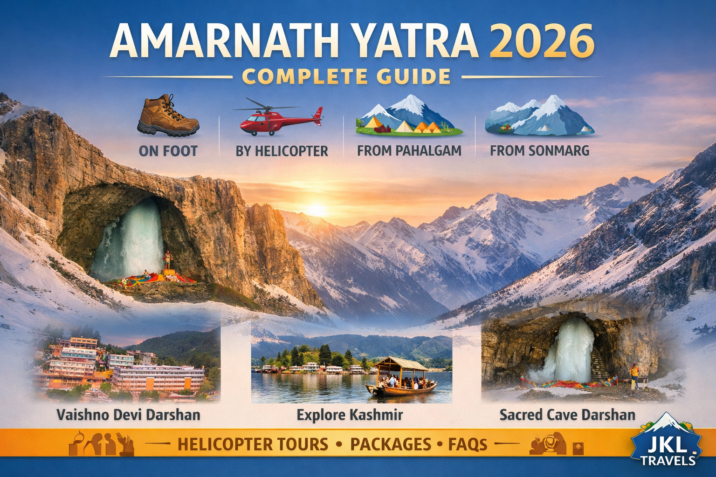
JKL TRAVELS | PILGRIMAGE SERIES 2026
🕉️
Shri Amarnath Yatra 2026
The Complete Pilgrim’s Guide
History · Routes · Itineraries · Costs · Paperwork · Do’s & Don’ts · FAQs
Yatra Dates: 3 July – 28 August 2026 | Registration Opens: 15 April 2026
The Sacred Story: History, Mythology & Tradition
Where It All Began
High in the Himalayan wilderness of South Kashmir, tucked inside a natural cave at an altitude of 3,888 metres above sea level, exists one of the most sacred shrines in Hinduism. The Amarnath Cave — known to devotees as the abode of Baba Barfani, the Icy Lord — is not simply a pilgrimage destination. It is, for millions of Hindus, a direct encounter with the divine.
The cave is home to a self-formed (swayambhu) ice Shivlinga — a naturally occurring stalagmite created by freezing water dripping from the cave ceiling. This ice formation waxes and wanes with the lunar cycle, reaching its fullest size around the full moon of Shravan month (July–August) and gradually diminishing thereafter. The phenomenon is considered miraculous: a physical manifestation of Lord Shiva’s presence that needs no human hand to create or maintain.
The Immortality of the Amar Katha
According to ancient Hindu tradition, the Amarnath Cave holds a significance beyond even its Shivlinga. It is believed to be the very spot where Lord Shiva narrated the Amar Katha — the secret of immortality — to Goddess Parvati. The story, told in the Bhrigu Samhita and referenced in several Puranas, describes Parvati’s persistent desire to understand why Shiva wears a garland of skulls (rudraksha) and why she must die and be reborn while he remains eternal.
Before entering the cave, Shiva systematically shed all his divine attributes: his vehicle Nandi the bull at Pahalgam (then called Bail Gaon), his snake ornaments at Anant Nag, the moon from his forehead at Chandanwari, and his son Ganesha at Mahagunas Pass. This journey of shedding became, over centuries, the pilgrimage route itself — every significant stop on the Pahalgam route corresponds to a place where Shiva left something behind on his way to share the ultimate secret.
Only one pair of ears is said to have overheard the Amar Katha — those of two white pigeons nesting in the cave. These pigeons, blessed by hearing the secret of immortality, are said to still inhabit the cave, and many pilgrims report sighting them. Their appearance is considered an auspicious sign.
Historical Records of the Pilgrimage
The pilgrimage to Amarnath is ancient beyond precise documentation. Historian Kalhana’s 12th-century Sanskrit chronicle Rajatarangini mentions the shrine. The 15th-century Kashmiri mystic poet Lal Ded wrote verses referencing Amarnath. In the colonial era, British administrator W.R. Lawrence’s 1895 account ‘The Valley of Kashmir’ documented the pilgrimage as an established, large-scale annual event. In the 20th century, the Shri Amarnathji Shrine Board (SASB) was constituted under state legislation to regulate, manage, and develop the Yatra in an organised manner.
Today, the Amarnath Yatra typically draws between 3 and 5 lakh pilgrims in a single season — making it one of the largest annual religious gatherings in South Asia. The management of this influx, across challenging high-altitude terrain and unpredictable weather, is a logistical undertaking of extraordinary scale.
The Shravan Connection: Why This Season Matters
The Yatra is traditionally undertaken during the holy month of Shravan (July–August in the Hindu calendar), which corresponds to the waxing period of the lunar cycle. The Shivlinga is at its largest on Jyeshtha Purnima (the full moon that typically marks the Yatra’s opening), and gradually reduces through the following weeks. Pilgrims who can time their visit to coincide with the full moon are considered especially fortunate. The Yatra concludes on Raksha Bandhan, when priests at the cave perform the final puja and the shrine is ceremonially closed for the season.
Types of Yatra: Every Path Leads to Baba’s Feet
Option 1: Amarnath Yatra on Foot via Pahalgam
The Pahalgam route is the traditional, historical path — the one that follows the footsteps of ancient pilgrims and aligns most closely with the mythological journey described in Hindu texts. It is longer, more gradual, and considerably more scenic than the Baltal route. Most first-time pilgrims who can dedicate the time choose this route.
Pahalgam Route — Day by Day
- Day 0 — Arrive at Nunwan Base Camp, Pahalgam (2,740 m). Register, collect RFID wristband, rest.
- Day 1 — Nunwan → Chandanwari (16 km, ~2,895 m). Gradual ascent through pine forest. The starting point of the legend — Shiva left his vehicles here.
- Day 2 — Chandanwari → Sheshnag (13 km, ~3,657 m). Cross Pissu Top (a steep initial climb), then descend to the emerald glacial Sheshnag Lake. Altitude gain is significant — acclimatize well.
- Day 3 — Sheshnag → Panchtarni (14 km, ~3,657 m). Cross the highest point of the trek, Mahagunas Pass (4,890 m). A long, demanding day — start early.
- Day 4 — Panchtarni → Holy Cave → Panchtarni (6 km each way, Cave at 3,888 m). The sacred day. Darshan at the cave, then return to Panchtarni camp.
- Day 5 — Return via same route or helicopter to Pahalgam.
TOTAL: 48 km one way | 3 to 5 days on foot | Altitude range: 2,740 m to 4,890 m (Mahagunas Pass)
Option 2: Amarnath Yatra on Foot via Baltal
The Baltal route is the faster, shorter option — popular with pilgrims who have limited time or who have done the Pahalgam route before and want a different experience. It is steeper and more physically demanding than Pahalgam despite being shorter. In recent years, it has grown significantly in popularity, particularly among younger pilgrims.
Baltal Route — Day by Day
- Day 0 — Arrive at Baltal Base Camp (2,743 m). Register, collect RFID wristband, rest. Baltal is ~87 km from Srinagar via the Sonamarg road.
- Day 1 — Baltal → Domail → Barari Marg → Holy Cave (14 km, ~ 4 to 6 hrs ascent). Steep, continuous climb. Many pilgrims use ponies or palkis for sections of the route.
- Day 2 (or same day) — Darshan and return descent to Baltal.
TOTAL: 14 km one way | 1 to 2 days on foot | Altitude range: 2,743 m to 3,888 m
Option 3: Amarnath Yatra by Helicopter
For pilgrims who cannot undertake the full trek — due to age, health conditions, time constraints, or physical limitations — the helicopter service has transformed access to Baba Barfani’s darshan. Since its introduction, it has made the Yatra accessible to hundreds of thousands of additional devotees, including elderly pilgrims and those with mobility challenges.
Important note: Even by helicopter, a 6-km trek or pony/palki ride remains mandatory from the Panchtarni helipad to the Holy Cave. Wheelchairs and litters (palkis carried by four bearers) are available at extra cost. The helicopter does not land at the cave itself.
2026 Helicopter Services — Routes & Approximate Fares
- Neelgrath (Baltal Side) → Panchtarni: ₹3,250 one-way | ₹6,500 return (Baltal route helicopter)
- Pahalgam Helipad → Panchtarni: ₹4,900 one-way | ₹9,800 return (Pahalgam route helicopter)
- Helicopter operators: Himalayan Heli, Global Vectra Helicorp, Arrow Aviation, Thumby Aviation
- Important: Round-trip booking mandatory in most cases | Baggage limit: 1 handbag, max 5 kg | Children under 2 fly free on adult’s lap
NOTE ON 2025: Helicopter services were suspended in 2025 due to a government No-Fly Zone order during the Yatra season. Services are expected to resume in 2026, but confirm official SASB announcements before booking. Avoid advance payments to unverified operators.
Pahalgam vs. Baltal: The Definitive Route Comparison
| Feature | Pahalgam Route (Traditional) | Baltal Route (Shorter) |
| Distance | 48 km (multi-day) | 14 km (1–2 days) |
| Difficulty | Moderate — gradual ascent | Steep — strenuous climb |
| Duration on Foot | 3 to 5 days | 1 to 2 days |
| Scenery | Chandanwari → Sheshnag → Panchtarni — highly scenic | Dramatic mountain views, less varied |
| Altitude at Cave | 3,888 m | 3,888 m |
| Helicopter Access | Pahalgam Helipad → Panchtarni | Neelgrath (Baltal) → Panchtarni |
| Trek from Panchtarni to Cave | 6 km (after helicopter drop) | 6 km (after helicopter drop) |
| Best For | First-timers, families, scenic experience | Short on time, fit trekkers |
| Spiritual Significance | Traditional route — historically preferred | Modern route — faster darshan |
| Facilities En Route | More camps, langars, medical posts | Fewer facilities — more rugged |
Our Recommendation: First-time pilgrims with 5 to 7 days should strongly consider the Pahalgam route for the complete traditional experience. Time-pressed pilgrims or those doing a return trip should choose Baltal or the helicopter option.
Formalities & Paperwork: Everything You Need Before You Go
Step 1: Compulsory Health Certificate (CHC)
Every pilgrim — without exception — must carry a valid CHC issued by an authorised doctor on or after 8 April 2026. No CHC means no Yatra permit — the rule is absolute. The certificate confirms that the pilgrim is medically fit for high-altitude trekking and does not have conditions (heart disease, severe lung disease, uncontrolled diabetes/hypertension) that would make the journey dangerous.
- CHC must be obtained from SASB-authorised doctors (list published on official website sasb.nic.in)
- Valid only when issued on or after 8 April 2026
- Pregnant women: Yatra is not permitted for any stage of pregnancy
- Age eligibility: Only pilgrims between 13 and 70 years of age may undertake the Yatra
- Children under 13 and adults over 70 are not permitted — no exceptions
Step 2: Advance Registration (Mandatory)
- Online registration: Official SASB website — sasb.nic.in
- Bank registration: 550+ designated branches of SBI, PNB, ICICI Bank, Axis Bank, Yes Bank, J&K Bank
- Registration opens: 15 April 2026
- You will receive a Yatra Permit specifying your travel date, route, and batch number
- IMPORTANT: Each registration slot specifies a date — you cannot change routes/dates casually. Plan your departure date carefully when registering.
Step 3: RFID Card Collection
- RFID wristband must be collected at Jammu or Kashmir base camps BEFORE starting the Yatra
- Must be worn at all times during the pilgrimage — it is your tracking and emergency identification
- Do not remove it until the Yatra is complete
- Collection points: Bhagwati Nagar Camp (Jammu), Nunwan Camp (Pahalgam), Baltal Camp
Step 4: ID Proof
- Government photo ID mandatory: Aadhaar card, driving licence, or passport
- Carry original + at least 2 photocopies
- Your registration permit must match the name and ID number on your identity document
Step 5: Helicopter Booking (If Applicable)
- Book helicopter tickets through SASB’s authorised portal once booking opens (typically April–May 2026)
- Demand significantly exceeds supply — book immediately when slots open
- Tickets are non-refundable and non-transferable
- Flights are weather-dependent; all helicopter operators reserve the right to cancel or reschedule due to poor visibility, cloud, or wind
- Carry confirmation print-out and the same ID used during registration
Step 6: Travel Insurance
While not currently mandatory, JKL Travels strongly recommends comprehensive travel insurance for all Amarnath Yatra pilgrims. Altitude sickness, weather delays, injury during the trek, and the occasional need for emergency helicopter evacuation are real possibilities. Standard travel insurance rarely covers high-altitude trekking above 3,000 m — specifically look for policies that include high-altitude medical coverage and emergency evacuation.
Do’s & Don’ts: The Pilgrim’s Code of Conduct
Do’s — Follow These for a Safe and Fulfilling Yatra
- Wear proper trekking shoes with ankle support — mandatory; slippers are strictly prohibited on the route
- Carry warm woollens regardless of weather forecast — temperature at the cave can drop below 0°C even in July
- Pack a waterproof rain poncho or jacket — monsoon showers are frequent and sudden
- Stay well hydrated — drink at least 3 to 4 litres of water daily
- Walk at a comfortable, steady pace — never rush at altitude
- Register and carry your RFID wristband at all times
- Carry personal medications plus standard altitude sickness tablets (Diamox — consult doctor first)
- Keep emergency contact numbers readily accessible — SASB helpline, JKL Travels 24/7 support
- Use eco-friendly practices — use designated bins, carry biodegradable packaging only
- Eat light — high-altitude digestion is slower; prefer simple vegetarian meals and dal-rice
- Follow all instructions from CRPF security personnel and SASB officials without hesitation
- Book ponies and palkis through official SASB-registered operators only — do not negotiate with unauthorised handlers
- Carry a first-aid kit with essentials: ORS packets, paracetamol, bandages, antiseptic cream
Don’ts — Avoid These at All Costs
- Never wear slippers, sandals, or floaters on the trek — falls on wet, rocky terrain are serious
- Do not take shortcuts off the marked trail — several pilgrims have been lost doing this
- Do not ignore symptoms of altitude sickness: severe headache, breathlessness at rest, vomiting, confusion — descend immediately
- Do not consume alcohol, caffeine in excess, or tobacco during the Yatra — all impair altitude adaptation
- Do not carry or use plastic bags, plastic bottles, or non-biodegradable packaging on the route
- Do not litter anywhere on the route or in the cave precincts
- Do not stop or rest at restricted zones marked by security personnel
- Do not photograph or film in restricted areas — these are clearly signposted
- Do not accept offers from unregistered guides, touts, or unofficial service providers
- Do not carry cash loosely — use a money belt; petty theft can occur at busy camp areas
- Do not post live location updates on social media from the route or camp areas
- Do not attempt the Yatra if you have uncontrolled heart disease, severe asthma, or are pregnant
The Complete Pilgrim Checklist
Documents
| ✓ Yatra Registration Permit (original + 2 copies) | ✓ Helicopter ticket confirmation (if applicable) |
| ✓ Compulsory Health Certificate (CHC) | ✓ Travel Insurance Policy Document |
| ✓ Government Photo ID — Aadhaar / Driving Licence / Passport | ✓ Emergency Contact Sheet (printed copy) |
| ✓ RFID Wristband (collect at Jammu/base camp) | ✓ Passport-size photographs (4 copies) |
Clothing & Gear
| ✓ Trekking shoes (mandatory — ankle support, waterproof preferred) | ✓ Gloves (waterproof preferred) |
| ✓ Woollen sweater / fleece jacket (minimum 2) | ✓ Trekking poles (optional but helpful on steep sections) |
| ✓ Thermal inner wear — top and bottom | ✓ Waterproof backpack / bag cover |
| ✓ Waterproof outer jacket / rain poncho | ✓ Sunglasses (UV protection — altitude sun is strong) |
| ✓ Woollen socks (4 to 5 pairs) | ✓ Sunscreen SPF 50+ and lip balm |
| ✓ Woollen cap / balaclava | ✓ Small torch / headlamp with spare batteries |
Health & Medical
| ✓ Diamox (Acetazolamide) — consult doctor before carrying | ✓ Antiseptic cream / ointment |
| ✓ Paracetamol / ibuprofen tablets | ✓ Personal prescription medicines (double the quantity needed) |
| ✓ ORS sachets (at least 10) | ✓ Anti-diarrhoeal tablets |
| ✓ Antacid tablets | ✓ Muscle pain relief spray / balm |
| ✓ Band-aids and wound dressing | ✓ Small digital thermometer |
Food & Nutrition
| ✓ Dry fruits — almonds, cashews, raisins (high-energy, light) | ✓ Instant oats or upma mix (for early morning quick meals) |
| ✓ Energy bars / protein bars (5 to 7 per day of trekking) | ✓ 2-litre reusable water bottle (BPA-free) |
| ✓ Glucose / electrolyte powder sachets | ✓ Small water purification tablets |
Combo Pilgrimage Itineraries & Group Costings
JKL Travels has designed four primary itinerary formats to cover the full range of pilgrimage combinations. All costings below are based on 3-star accommodation, on twin/double sharing basis, including breakfast and dinner, private AC vehicle transfers, and standard inclusions. Costs are per person. Air/train fare is excluded unless specified.
COST DISCLAIMER: All costings are indicative for 2026 based on current market rates. Final costs depend on actual travel dates, availability, and flight prices. Contact JKL Travels for personalised confirmed quotes. GST @5% is additional on all packages.
Itinerary A: Amarnath Yatra Only — Helicopter via Baltal (05 Days / 04 Nights)
Routing: Srinagar → Sonamarg → Baltal → Amarnath → Srinagar
- Day 1 — Arrive Srinagar. Airport pickup. Transfer and check-in at 3-star hotel. Evening briefing on Yatra paperwork, RFID card collection. Overnight Srinagar.
- Day 2 — Early breakfast. Drive Srinagar → Sonamarg (80 km / 2.5 hrs). Check-in at 3-star hotel. Acclimatisation walk, rest. Overnight Sonamarg.
- Day 3 — Yatra Day. Early start. Drive Sonamarg → Neelgrath Helipad (Baltal, 6 km / 20 mins). Board helicopter to Panchtarni. 6 km trek / pony / palki to Holy Cave. Darshan. Return to Panchtarni helipad. Return flight to Neelgrath. Drive back to Sonamarg. Overnight Sonamarg.
- Day 4 — Drive Sonamarg → Srinagar. Dal Lake Shikara ride. Evening at leisure. Overnight Srinagar.
- Day 5 — Breakfast. Check-out. Transfer to Srinagar Airport. Departure.
INCLUSIONS: 3-star hotel (4 nights) | Daily breakfast & dinner | AC vehicle throughout | Helicopter ticket (round-trip Neelgrath–Panchtarni) | Airport transfers | RFID collection assistance | 24/7 JKL support
EXCLUSIONS: Flights | SASB Registration fee | CHC | Pony / Palki at cave (₹400–₹1,200 one-way) | Lunches | Travel insurance | GST 5%
INDICATIVE COSTINGS — ITINERARY A (Per Person, 3-Star, ₹)
| Cost Component | 2 Pax | 4 Pax | 6 Pax | 10 Pax | 14 Pax | 16 Pax | Notes |
| 3-Star Hotel (4 nights, BB+DB) | 6,000 | 5,500 | 5,200 | 4,800 | 4,500 | 4,200 | Per person per night (twin sharing) |
| AC Vehicle Transfers | 3,200 | 2,200 | 1,800 | 1,400 | 1,100 | 1,000 | Per person; larger groups use Tempo Traveller/bus |
| Helicopter RT (Neelgrath) | 6,500 | 6,500 | 6,500 | 6,500 | 6,500 | 6,500 | Fixed SASB rate; no group discount |
| RFID + Registration Assistance | 300 | 300 | 300 | 300 | 300 | 300 | Documentation support |
| Misc (Shikara, porterage etc) | 800 | 700 | 600 | 500 | 450 | 400 | Per person estimate |
| TOTAL PER PERSON (approx) | 16,800 | 15,200 | 14,400 | 13,500 | 12,850 | 12,400 | Excl. flights, CHC, GST 5% |
Itinerary B: Amarnath Yatra + Kashmir Sightseeing (08 Days / 07 Nights)
Routing: Srinagar → Gulmarg → Sonamarg → Amarnath (Helicopter) → Pahalgam → Srinagar
- Day 1 — Arrive Srinagar. Airport pickup. Check-in 3-star hotel. Evening orientation + RFID collection. Overnight Srinagar.
- Day 2 — Srinagar sightseeing: Mughal Gardens (Nishat Bagh, Shalimar Bagh), Shankaracharya Temple. Evening Shikara ride on Dal Lake. Overnight Srinagar / Houseboat.
- Day 3 — Drive to Gulmarg (56 km / 1.5 hrs). Gondola ride Phase I + II. Meadow walks. Overnight Gulmarg 3-star.
- Day 4 — Drive Gulmarg → Sonamarg (via Srinagar, 130 km / 3 hrs). Check-in. Rest + acclimatisation. Overnight Sonamarg.
- Day 5 — YATRA DAY. Neelgrath Helipad → Panchtarni → Holy Cave → Darshan → Return to Baltal → Drive Sonamarg. Overnight Sonamarg.
- Day 6 — Drive Sonamarg → Pahalgam (175 km / 4 hrs via Srinagar). Afternoon: Betaab Valley / Baisaran Meadow visit (confirm current access). Overnight Pahalgam 3-star.
- Day 7 — Pahalgam: Lidder River walk, Aru Valley. Afternoon drive back to Srinagar. Local market / handicraft shopping. Overnight Srinagar.
- Day 8 — Breakfast. Check-out. Srinagar Airport transfer. Departure.
INDICATIVE COSTINGS — ITINERARY B (Per Person, 3-Star, ₹)
| Cost Component | 2 Pax | 4 Pax | 6 Pax | 10 Pax | 14 Pax | 16 Pax | Notes |
| 3-Star Hotel (7 nights, BB+DB) | 5,800 | 5,400 | 5,100 | 4,700 | 4,400 | 4,100 | Includes Houseboat (1 night Srinagar) |
| AC Vehicle (all transfers) | 4,200 | 3,000 | 2,400 | 1,900 | 1,500 | 1,350 | Per person; Innova/Tempo Traveller by group size |
| Helicopter RT (Neelgrath) | 6,500 | 6,500 | 6,500 | 6,500 | 6,500 | 6,500 | Fixed SASB fare |
| Gondola (Gulmarg Phase I+II) | 1,800 | 1,800 | 1,800 | 1,800 | 1,800 | 1,800 | Fixed cable car tariff |
| Misc & Sightseeing entries | 1,200 | 1,000 | 900 | 800 | 750 | 700 | Per person |
| TOTAL PER PERSON (approx) | 19,500 | 17,700 | 16,700 | 15,700 | 14,950 | 14,450 | Excl. flights, CHC, GST 5% |
Itinerary C: Vaishno Devi + Amarnath Yatra (07 Days / 06 Nights)
Routing: Jammu → Katra (Vaishno Devi) → Srinagar → Baltal → Amarnath → Srinagar
- Day 1 — Arrive Jammu by flight/train. Transfer to Katra (56 km / 2 hrs). Check-in 3-star hotel. Evening puja preparation. Overnight Katra.
- Day 2 — VAISHNO DEVI DARSHAN. Early morning: 14 km trek to Bhawan (or helicopter to Sanjichhat + short walk). Darshan at the three pindis: Maha Kali, Maha Lakshmi, Maha Saraswati. Return to Katra. Overnight Katra.
- Day 3 — Early drive Katra → Srinagar (280 km / 8 hrs via NH-44). Check-in 3-star hotel Srinagar. RFID collection + registration verification. Overnight Srinagar.
- Day 4 — Drive Srinagar → Sonamarg (80 km). Acclimatisation, rest. Overnight Sonamarg 3-star.
- Day 5 — AMARNATH YATRA DAY. Neelgrath Helipad → Panchtarni → Holy Cave → Darshan → Return. Overnight Sonamarg.
- Day 6 — Drive Sonamarg → Srinagar. Shikara ride on Dal Lake. Evening leisure. Overnight Srinagar.
- Day 7 — Breakfast, check-out. Srinagar Airport transfer. Departure.
VAISHNO DEVI HELICOPTER NOTE: Vaishno Devi helicopter (Katra → Sanjichhat) costs approximately ₹4,500 return per person. This is optional; the 14-km trek is well-paved and manageable for most pilgrims. Ponies and palkis are also available at extra cost.
INDICATIVE COSTINGS — ITINERARY C (Per Person, 3-Star, ₹)
| Cost Component | 2 Pax | 4 Pax | 6 Pax | 10 Pax | 14 Pax | 16 Pax | Notes |
| 3-Star Hotel (6 nights, BB+DB) | 5,600 | 5,200 | 4,900 | 4,500 | 4,200 | 3,900 | Katra 2 nights + Sonamarg 1 + Srinagar 3 |
| AC Vehicle (Jammu–Katra–Srinagar) | 4,800 | 3,400 | 2,700 | 2,100 | 1,700 | 1,550 | Jammu–Srinagar leg is long; larger groups more economical |
| Amarnath Heli RT (Neelgrath) | 6,500 | 6,500 | 6,500 | 6,500 | 6,500 | 6,500 | Fixed SASB fare |
| VD Helicopter RT (optional) | 4,500 | 4,500 | 4,500 | 4,500 | 4,500 | 4,500 | Optional — trek is free. If not taken, deduct ₹4,500 |
| Misc & documentation | 1,200 | 1,000 | 900 | 800 | 750 | 700 | Per person |
| TOTAL with VD Heli (approx) | 22,600 | 20,600 | 19,500 | 18,400 | 17,650 | 17,150 | Both helicopters included |
| TOTAL without VD Heli (approx) | 18,100 | 16,100 | 15,000 | 13,900 | 13,150 | 12,650 | Amarnath Heli only |
Itinerary D: Vaishno Devi + Amarnath + Kashmir Grand Pilgrimage (11 Days / 10 Nights)
Routing: Jammu → Katra → Srinagar → Gulmarg → Sonamarg → Amarnath → Pahalgam → Srinagar
- Day 1 — Arrive Jammu. Transfer Katra (56 km). Check-in 3-star. Orientation. Overnight Katra.
- Day 2 — VAISHNO DEVI. Early morning darshan (trek / helicopter). Return to Katra. Evening rest. Overnight Katra.
- Day 3 — Drive Katra → Srinagar (280 km / 8 hrs). En route visit Patnitop viewpoint. Check-in Srinagar. RFID collection. Overnight Srinagar.
- Day 4 — Srinagar: Mughal Gardens, Shankaracharya Temple, handicraft market. Afternoon: Shikara ride on Dal Lake. Overnight Srinagar / Houseboat.
- Day 5 — Drive to Gulmarg. Gondola Phase I + II. Afternoon meadow exploration. Overnight Gulmarg 3-star.
- Day 6 — Drive Gulmarg → Sonamarg (via Srinagar, 130 km). Check-in. Rest + altitude preparation. Overnight Sonamarg.
- Day 7 — AMARNATH YATRA DAY. Helicopter Neelgrath–Panchtarni. Darshan. Return to Sonamarg. Overnight Sonamarg.
- Day 8 — Drive Sonamarg → Pahalgam (175 km via Srinagar). Betaab Valley / Aru Valley visit. Overnight Pahalgam 3-star.
- Day 9 — Pahalgam: Lidder riverside walk, local market, scenic exploration. Afternoon drive to Srinagar. Shopping. Overnight Srinagar.
- Day 10 — Srinagar: Optional morning Shikara / leisure. Afternoon departure preparations. Overnight Srinagar.
- Day 11 — Breakfast. Check-out. Srinagar Airport transfer. Departure.
INDICATIVE COSTINGS — ITINERARY D (Per Person, 3-Star, ₹)
| Cost Component | 2 Pax | 4 Pax | 6 Pax | 10 Pax | 14 Pax | 16 Pax | Notes |
| 3-Star Hotels (10 nights, BB+DB) | 5,800 | 5,300 | 5,000 | 4,600 | 4,300 | 4,000 | Multiple destinations |
| All AC Vehicle Transfers | 5,500 | 3,900 | 3,100 | 2,400 | 2,000 | 1,800 | Jammu-Katra-Srinagar + all local routes |
| Amarnath Heli RT (Neelgrath) | 6,500 | 6,500 | 6,500 | 6,500 | 6,500 | 6,500 | Fixed SASB |
| Gondola (Gulmarg) | 1,800 | 1,800 | 1,800 | 1,800 | 1,800 | 1,800 | Fixed tariff |
| VD Helicopter RT (optional) | 4,500 | 4,500 | 4,500 | 4,500 | 4,500 | 4,500 | Optional add-on |
| Shikara + sightseeing entries | 1,500 | 1,300 | 1,200 | 1,000 | 900 | 850 | Per person |
| TOTAL with VD Heli (approx) | 25,600 | 23,300 | 22,100 | 20,800 | 20,000 | 19,450 | All helicopters + all sightseeing |
| TOTAL without VD Heli (approx) | 21,100 | 18,800 | 17,600 | 16,300 | 15,500 | 14,950 | Amarnath Heli + all sightseeing |
GROUP SAVINGS: Groups of 10 and above save approximately 20–25% per person on vehicle costs versus a couple’s rate. Groups of 16 travel in comfortable Tempo Traveller coaches and save most on transport.
Important FAQs — Amarnath Yatra 2026
Q1. What are the official Amarnath Yatra 2026 dates?
The Shri Amarnath Yatra 2026 officially runs from 3 July 2026 to 28 August 2026 — a total of 57 days. Advance registration opens on 15 April 2026.
Q2. What is the Compulsory Health Certificate (CHC) and where do I get it?
The CHC is a medical certificate confirming you are physically fit for high-altitude trekking. It must be obtained from an SASB-authorised doctor and must be dated on or after 8 April 2026. A list of authorised doctors is available on sasb.nic.in. Without a valid CHC, you cannot register for or undertake the Yatra.
Q3. Who is NOT allowed on the Yatra?
Pilgrims below 13 or above 70 years of age, pregnant women at any stage, and anyone with uncontrolled cardiac conditions, severe respiratory disease, or any condition that the authorised doctor deems incompatible with high-altitude trekking. There are no exceptions to the age rule.
Q4. Which route is better — Pahalgam or Baltal?
It depends on your available time, fitness level, and experience. Pahalgam is the traditional, scenic, gradual route (48 km, 3–5 days) — ideal for first-timers and those wanting the complete pilgrimage experience. Baltal is shorter (14 km, 1–2 days) but steeper and more physically demanding. If you’re combining with Kashmir sightseeing or have just 1–2 days for the Yatra itself, Baltal (especially by helicopter) is the practical choice.
Q5. Can I complete the Yatra entirely without trekking?
Not entirely. Even with the helicopter service, a 6-km trek from the Panchtarni helipad to the Holy Cave remains mandatory. Palki (a litter carried by 4 bearers) and pony rides are available at extra cost for those who cannot walk. The SASB has limited options for pilgrims with severe mobility impairment — contact them directly for special needs assistance.
Q6. What are the 2026 helicopter fares?
Indicative 2026 fares based on SASB announcements: Neelgrath (Baltal) to Panchtarni — ₹3,250 one-way / ₹6,500 return. Pahalgam to Panchtarni — ₹4,900 one-way / ₹9,800 return. Note: These fares are subject to revision. In 2025, helicopter services were suspended due to a government No-Fly Zone order — confirm 2026 status directly with SASB before making payments.
Q7. How far in advance should I register?
Immediately when registration opens on 15 April 2026. Both online and bank registration slots fill fast, particularly for peak dates in July. If you want to travel in July, register on or very close to April 15. Waiting even 2–3 weeks can mean limited slot availability.
Q8. What happens if my preferred date is fully booked?
Choose an alternate available date when registering. The Yatra runs until 28 August, so there is flexibility. If you must travel on a specific date, register through multiple channels (online + bank) simultaneously.
Q9. Is mobile phone connectivity available during the Yatra?
Connectivity is available at base camps (Nunwan/Pahalgam, Baltal) and partially at Sheshnag and Panchtarni. It becomes unreliable or absent at higher elevations and inside the cave. BSNL has the best coverage along the route. Carry a fully charged power bank. Do not rely on mobile connectivity for emergencies — use the SASB emergency communication systems available at each camp.
Q10. What food is available on the route?
All food on the Yatra route and at the cave is strictly vegetarian. Community langars (free community kitchens run by various trusts and organisations) operate at all major camps and provide simple dal, rice, khichdi, and tea at no cost. Hot packaged meals and snacks are available at base camps and major stops. On the higher sections of the trek (above Sheshnag and beyond), options become limited — carry your own energy bars, dry fruits, and glucose.
Q11. Can women travel alone on the Yatra?
Yes. Solo women pilgrims undertake the Yatra every year. Security is robust along the official route. JKL Travels recommends solo women book through an organised group or guided tour for additional support and safety, particularly for overnight camp stays. Register with SASB solo women’s assistance program if travelling independently.
Q12. What is the typical temperature at the Amarnath Cave?
The cave is at 3,888 metres. Even during the peak Yatra months of July and August, temperatures at the cave range between -5°C and 10°C. After rainfall or at night, they drop further. The weather is highly unpredictable — sunshine can turn to snowfall in minutes. Always carry sufficient warm clothing, regardless of how warm it feels at the base camp.
Q13. What is Acute Mountain Sickness (AMS) and how do I prevent it?
AMS is a physiological response to reduced oxygen at high altitude. Symptoms include persistent headache, nausea, vomiting, dizziness, and breathlessness at rest. Prevention: ascend gradually, stay hydrated, avoid alcohol, eat light, and rest adequately. Medical assistance posts are available at every major camp. If symptoms are severe — especially confusion or inability to walk straight — descend immediately and seek medical help. Do not ascend further with AMS symptoms.
Q14. Is the Pahalgam Yatra route fully open in 2026?
As of available information, the Pahalgam Yatra route starts at Nunwan Base Camp near Pahalgam town. Note that some recreational tourist sites near Pahalgam (Baisaran, Betaab Valley, Aru Valley) are being reopened in phases after the April 2025 security incident. The Yatra route itself is a separate infrastructure managed by SASB and security forces — confirm final route status with SASB when registration opens.
Q15. Can I combine Vaishno Devi and Amarnath in a single trip?
Absolutely, and it is one of the most popular pilgrimage combinations in India. The standard order is Vaishno Devi first (Katra, Jammu region), then drive up to Srinagar and proceed to Amarnath. This is a 7-day journey at minimum, and JKL Travels’ Itinerary C covers this exactly. Combining both shrines in one journey is considered especially auspicious.
Q16. What transport do I need a postpaid mobile connection for?
BSNL and Airtel postpaid connections work best in the J&K region. Pre-paid connections and SIMs from other states may face restrictions in certain areas. If you are travelling from outside J&K, obtain a BSNL postpaid connection or check with your operator about roaming in J&K before departure. Alternatively, purchase a local J&K SIM on arrival at Jammu or Srinagar.
Q17. What is the RFID card and can I lose it?
The RFID (Radio Frequency Identification) wristband is your real-time tracking and identification tool during the Yatra. Security forces and SASB personnel use it to monitor pilgrim movement, coordinate emergency response, and manage camp density. If lost, report immediately to the nearest SASB camp office for replacement. Losing it and not reporting it is a serious safety risk — both for you and for search-and-rescue teams.
Q18. Are there any sections of the trek where pony or palki is mandatory?
No section is mandatory by pony or palki — you can walk the entire route on foot. However, palkis and ponies are strongly recommended for elderly pilgrims, anyone with joint issues, or those experiencing physical difficulty on the Pissu Top section (Pahalgam route) or the steep final ascent from Panchtarni to the cave. Book through SASB-registered operators only — rates are regulated.
Q19. What is the cancellation policy for JKL Travels Yatra packages?
Standard cancellation terms: cancellation 30+ days before departure — 25% of total package cost. 15–30 days before — 50%. 0–15 days before — 100%. Note that SASB registration fees, RFID charges, and helicopter ticket costs are generally non-refundable once issued, regardless of operator policy. Travel insurance is strongly recommended to cover cancellation due to medical emergencies.
Q20. What should I do if I need emergency help on the route?
SASB maintains medical posts, army field hospitals, and emergency communication points at all major camps along both routes. CRPF security personnel are deployed throughout. SASB emergency helpline: 0194-2313149 / 2313154. JKL Travels provides a 24/7 ground support contact to all our Yatra clients. Each pilgrim also carries an emergency contact sheet in their documentation pack. In the event of a medical emergency, the nearest camp can arrange emergency helicopter evacuation if required.
JKL TRAVELS | Your Trusted Yatra Partner Since 2003
Srinagar Office: www.jkltravels.com | Official SASB: sasb.nic.in | SASB Helpline: 0194-2313149
All information is fact-checked against official SASB sources and ground reports as of May 2026. Yatra dates, fares, and regulations are subject to change — always verify on sasb.nic.in before booking.
