JKL TRAVELS | GROUND REPORT: HIMALAYAN DESTINATIONS 2026
Published: May 2026 | By: JKL Travels Editorial & Ground Team | Verified: Ground Reports + Official Tourism Sources
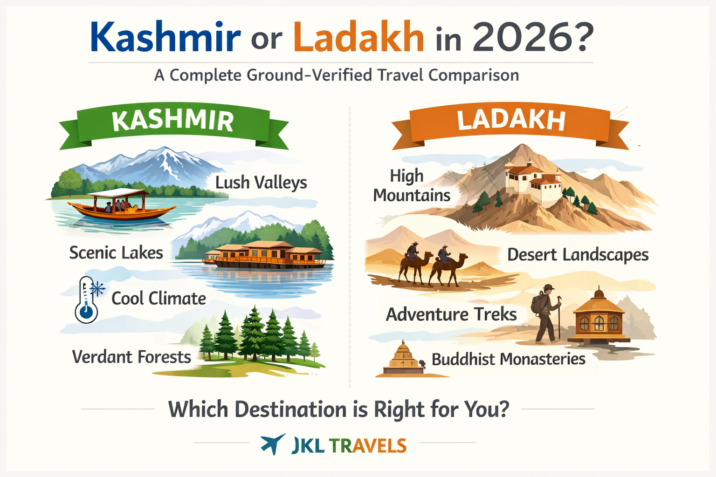
Kashmir or Ladakh in 2026?
We Went to Both. Here’s the Truth.
A fact-checked, ground-verified mega-guide comparing every dimension of India’s two greatest Himalayan destinations — so you can stop debating and start booking.
“Kashmir makes you feel. Ladakh makes you think. The lucky ones get to experience both.”
— JKL Travels, Srinagar Ground Team
The Question Every Traveler Asks — And What the Answer Actually Depends On
It starts the same way every time. Someone books flights, clears their leave, and then opens Google — and gets completely stuck. Two open tabs. Two unthinkable choices. Kashmir or Ladakh?
They’re both in India’s northernmost frontier. Both ringed by the Himalayas. Both capable of producing the kind of travel memories that rearrange your sense of what the world is. And yet, they are fundamentally, profoundly different — as different as a Mughal garden is from a Tibetan monastery, as a shikara gliding across Dal Lake is from a Royal Enfield grinding up Khardung La.
We have been sending travelers to both destinations for over two decades. We have drivers in Srinagar and guides in Leh. We know which route is best for first-timers, which camps near Pangong are worth the price, which months to avoid at all costs, and — as of this ground-verified 2026 update — where you can now go safely and what still requires caution.
This is not a listicle. This is a guide built on real experience, updated for 2026 conditions. Read it fully before you decide.
The Landscape Divide: Emerald Valley vs. Red Planet
Kashmir: The Valley That Convinced Emperors to Stay
The Mughal emperor Jahangir, who spent decades in Kashmir, reportedly said he wanted nothing from heaven but Kashmir. That’s either the highest compliment ever paid to a valley, or a testament to the fact that some places are simply too good to leave voluntarily.
Kashmir’s landscape is defined by abundance. Water everywhere — rivers, lakes, glacial streams, springs. Green so saturated it looks fictional — pine forests, willows, meadows, orchards. Snow-dusted peaks rising behind them like theatre backdrops that somebody forgot to take down.
The valley sits at a comfortable 1,600 to 2,700 metres, which means the scenery is dramatic without the altitude being punishing. You can walk into Gulmarg’s meadows and breathe freely. You can sit by the Lidder River in Pahalgam and feel the spray. You can take a shikara across Dal Lake at 6 a.m. and watch the city wake up around you — vegetable vendors rowing their small wooden boats through floating gardens, the mountains still pink in the early light.
Kashmir’s key landscapes:
- Dal Lake and Nagin Lake, Srinagar — the houseboat experience and shikara rides that define Kashmir for most visitors
- Gulmarg — meadows, gondola rides to 3,979 metres, Asia-class ski slopes in winter
- Sonamarg — the Glacier Meadow, gateway to Ladakh, one of Kashmir’s most cinematic valleys
- Pahalgam — pine forests, the Lidder River (Baisaran, Aru, and Betaab partially reopened Feb 2026; confirm status before visiting)
- Doodhpathri and Yousmarg — quieter, locally beloved meadows away from the main tourist trail
Ladakh: The Place That Reminds You the Earth Is Very Old
There is nothing gentle about Ladakh’s landscape. It does not ease you in. You arrive in Leh — either by a 70-minute flight that deposits you at 3,524 metres, or after two days of driving through some of the world’s most extreme road conditions — and it hits you immediately: the sheer, geological brutality of the place.
These are not mountains with forests. These are mountains stripped to their skeleton — billions of years of uplift, erosion, and tectonic drama written in exposed rock faces that glow rust, ochre, and violet at different hours of the day. The sky is bluer than anywhere you’ve been. The rivers are the colour of glacial milk. And somewhere in the middle of all this ancient drama, a line of prayer flags snaps in the wind above a monastery that has stood since the 10th century.
Ladakh’s key landscapes:
- Pangong Tso — 134 km long, sitting at 4,350 m; changes colour from turquoise to indigo depending on time and cloud; 70% lies across the border in Tibet
- Nubra Valley — reached via Khardung La (5,359 m); Bactrian camels at Hunder, sand dunes against snow peaks
- Zanskar Valley — remote, rarely visited, impossibly dramatic; the Zanskar River freezes over in winter for the Chadar Trek
- Hemis, Thiksey, Diskit, Alchi monasteries — each worthy of half a day’s visit
- Tso Moriri and Tso Kar — wilder, quieter alternatives to Pangong for those who want solitude
When to Go: The Seasonal Truth About Both Destinations
Kashmir: Open Almost Year-Round, Magnificent in Every Season
This is one of Kashmir’s biggest competitive advantages. While Ladakh is cut off by road for six months of the year, Kashmir welcomes visitors in every season — and each season genuinely offers a different and compelling experience.
March to April — Bloom Season
The Indira Gandhi Tulip Garden in Srinagar — Asia’s largest, with over 1.5 million tulips across 64 varieties — opens in late March. The valley is fresh, the air is clean, and hotel prices are still reasonable before the summer rush.
May to August — Peak Season
The warmest, busiest, and most accessible months. Families, honeymooners, and group tours converge on Srinagar, Gulmarg, and Pahalgam. All sights are fully open, weather is reliably pleasant (15°C to 30°C), and the tourism infrastructure is operating at full capacity. Book accommodation at least 6–8 weeks ahead.
September to October — The Smart Traveler’s Window
Arguably the best-kept secret in Kashmir tourism. Crowds thin from September, chinar trees start turning amber by mid-October, and prices soften noticeably. Delhi to Srinagar return flights drop to around ₹9,000 to ₹14,000 in October. For couples and photographers, this is often the most rewarding time to visit.
December to February — Winter and Ski Season
Gulmarg in winter is world-class. The resort receives 5–10 feet of natural snowfall annually and the Gondola provides access to off-piste terrain that attracts experienced skiers from Europe and Central Asia. Temperatures in Gulmarg can drop to -10°C, but the experience is unforgettable. Srinagar itself is cold and misty — charming for the right temperament.
Ladakh: A Short, Brilliant Window — Plan Around It
Ladakh’s road-accessible season runs from approximately late May to mid-October, with June to September being the reliable core. Outside these months, the Srinagar–Leh and Manali–Leh highways are closed. To put this in concrete terms: the Zojila Pass on the Srinagar–Leh route was kept open only until January 6, 2025 before closing for 68 consecutive days due to heavy snowfall.
June to September — The Only Road Window
This is when all of Ladakh is accessible. Pangong is reachable, Nubra is open, Hemis Festival takes place (usually June/July), and the weather — while cold at night — is manageable during the day (10°C to 20°C). Book everything in advance: peak-season accommodation at quality camps near Pangong sells out months ahead.
January to February — Air Access Only, Extreme Adventure
Only Leh is accessible (by air only). The Chadar Trek — walking on the frozen Zanskar River through a sheer-walled gorge — operates in January and February. Temperatures can drop to -20°C. This is for committed adventure travelers and seasoned trekkers only.
JKL TRAVELS TIP: If you want to combine both destinations in a single trip, fly into Srinagar, spend 4–5 days in Kashmir, then drive the Srinagar–Leh Highway in two days (overnight in Kargil), and continue into Ladakh. This is the most scenic and acclimatization-friendly itinerary available.
Safety in 2026: A Direct, Honest Update
Kashmir: Stable and Open — With Important Nuances
After the tragic April 22, 2025 attack at Baisaran Meadow near Pahalgam — which temporarily halted tourism across several parts of the valley — Kashmir’s security situation has significantly stabilized. As of February 2026, the J&K administration officially reopened 14 tourist destinations that had been closed following a detailed security review involving police, intelligence, and civil authorities.
The main tourist circuit — Srinagar, Gulmarg, Sonamarg, and Pahalgam town — is fully operational with enhanced security: increased police deployment, tourist helplines (8899941010 / 8899931010), CCTV surveillance at high-footfall points, and dedicated Tourist Police Help Centres. Tourism numbers have steadily recovered throughout 2025 and continue to grow.
What you need to know for 2026:
- Srinagar, Gulmarg, and Sonamarg: fully open, normal tourism
- Pahalgam town: open. Baisaran Meadow, Aru Valley, and Betaab Valley: being reopened in phases — confirm current access status with your operator before departure
- Remote border areas (Line of Control zones): avoid — these are not tourist circuits
- Travel with a registered, experienced local operator; follow official J&K Tourism advisories
IMPORTANT: JKL Travels monitors security conditions on the ground daily through our Srinagar team. We will not operate tours to any site where conditions are uncertain. Your safety is built into every itinerary we design.
Ladakh: Secure and Well-Managed — Know Your Permits
Ladakh is stable from a security standpoint. The challenges are geographical. Inner Line Permits are required for border-area destinations including Pangong Tso, Nubra Valley, and Tso Moriri — these are straightforward to obtain online or through your operator in Leh for a small fee (₹200–₹500 per person). Always carry ID and permit copies when traveling to restricted areas.
Culture and Food: Two Entirely Different Civilisations
Kashmir: Where Every Craft Has a 400-Year History
Spend an afternoon in Srinagar’s old city and you’ll understand why Kashmir has been called the ‘Venice of the East’ and the ‘Switzerland of Asia’ and about a dozen other superlatives that all fail to fully capture what it actually is. It is a civilisation layered over centuries of Persian, Mughal, Sufi, and Central Asian influence, and every layer is still visible.
The wood carvers of Srinagar work on walnut patterns that haven’t fundamentally changed since the 16th century. Pashmina weavers produce shawls that require months of work per piece. The papier-mâché artisans of Rainawari paint miniature patterns so fine they use brushes made from a single strand of hair.
And then there’s the food. The Kashmiri wazwan is not a meal — it is an event. Traditionally served at weddings and major celebrations, it can include up to 36 courses, served in large copper bowls called traami, shared by four guests sitting together. Rogan Josh (slow-braised lamb in aromatic spices), Gushtaba (meatballs in yogurt curry), Rista (mince meatballs in red sauce), and Yakhni (lamb in yogurt and fennel) are the anchor dishes of this remarkable culinary tradition. Wash it down with Kahwa — green tea with saffron, cardamom, rose petals, and crushed almonds — and you’ll understand why Kashmiri hospitality has a reputation that extends well beyond the valley.
Ladakh: Ancient, Austere, Profoundly Spiritual
Ladakh’s culture was shaped not by trade routes or court patronage, but by altitude and isolation. For centuries, communities here developed in near-complete self-sufficiency, producing a culture that is quietly extraordinary — deeply rooted in Tibetan Buddhism, expressed through monasteries, prayer flags, festivals, and a relationship with the natural world that is simultaneously practical and sacred.
The Hemis Festival — held in the Hemis Monastery courtyard, usually in June or July — is the centrepiece of Ladakh’s cultural calendar. Monks in elaborate silk costumes perform Cham dances over two days, re-enacting the victory of good over evil in a ceremony that dates back centuries. The Ladakh Festival in September and the Losar (Tibetan New Year) celebration in winter are equally worth experiencing if your timing aligns.
Food in Ladakh is about warmth and fuel. Thukpa (a Tibetan noodle soup, hearty and deeply satisfying at altitude), Momos (steamed dumplings), Skyu (a thick pasta and vegetable stew), and the famous Butter Tea (tea churned with yak butter and salt — an acquired taste that grows on you quickly in cold weather) are the staples. Leh’s café scene has evolved significantly in recent years, and the Main Bazaar now offers everything from fresh-baked croissants to excellent wood-fired pizzas.
Adventure: Kashmir Offers It; Ladakh Lives It
Kashmir: Real Adventure, Accessible to Real People
Let’s be clear: Kashmir is not a passive destination. Skiing the off-piste runs above Gulmarg’s Phase II gondola at 3,979 metres requires skill and fitness. Trekking the Kashmir Great Lakes circuit — a 70-km trail through six high-altitude lakes at 3,500 to 4,200 metres — is a serious undertaking. River rafting Grade 3 rapids on the Lidder in Pahalgam is genuine adventure. The difference is that these experiences are calibrated for a range of fitness levels and require no special experience or altitude preparation.
Kashmir adventure highlights:
- Skiing and snowboarding in Gulmarg (December to March) — one of Asia’s top ski destinations at 2,690 m base
- Gulmarg Gondola Phase II — reaches 3,979 m; spectacular Himalayan panoramas year-round
- Kashmir Great Lakes Trek — 7 to 8 days, 6 high-altitude lakes, one of India’s finest long treks
- River rafting on the Lidder (Pahalgam) — Grade 2 to 3, suitable for beginners
- Camping at Sonamarg — glaciers and pristine alpine lakes accessible on day hikes
- Paragliding and cycling tours in the Srinagar Valley
Ladakh: India’s Adventure Capital — No Argument
If Kashmir’s adventure is a beautiful sentence, Ladakh’s is a whole novel. The Manali–Leh Highway — a two-day road journey over five high passes, none below 4,300 metres — is consistently listed among the world’s great road trips. The Zanskar River rafting expedition (Class 4 to 5 rapids through a sheer-walled canyon that receives no direct sunlight for parts of the year) is in a different category entirely from anything Kashmir offers.
Ladakh adventure highlights:
- Royal Enfield / adventure bike expeditions on Manali–Leh Highway (June–September only) — 479 km of legendary road
- Stok Kangri Summit — 6,153 m, the highest trekking peak accessible without technical climbing in India
- Markha Valley Trek — 8 to 10 days through remote Ladakhi villages and high passes
- Zanskar River Rafting — 7 to 8 days, Class 4 to 5; one of the world’s most dramatic river journeys
- Chadar Trek — January to February only; walking the frozen Zanskar River at -20°C
- Bactrian camel safari at Hunder, Nubra Valley — genuinely surreal, worth it
- Stargazing at Hanle — one of the world’s highest altitude observatories; zero light pollution
Your Body at Altitude: What to Expect in Each Destination
Kashmir: No Altitude Concerns for the Average Traveler
At 1,600 to 2,700 metres, Kashmir sits in a zone that most healthy adults — including children and the elderly — navigate without any difficulty. Breathing is normal from day one, sleep is comfortable, and physical activity is unrestricted. If you have a pre-existing cardiac or respiratory condition, consult your doctor before any mountain travel, but Kashmir’s altitude is not a barrier for the vast majority of travelers.
Ladakh: Respect the Altitude or the Altitude Will Not Respect You
Leh is at 3,524 metres. Pangong Tso is at 4,350 metres. Khardung La is at 5,359 metres. These are not numbers to read and forget. Acute Mountain Sickness (AMS) is real, it’s common, and it does not care how fit you are or how many mountains you’ve climbed before. It affects roughly 25–40% of travelers who ascend to Leh too quickly without acclimatization.
The JKL Travels acclimatization protocol:
- Arrive in Leh and rest for 24 to 48 hours — no sightseeing, no exertion
- Drink 3–4 litres of water daily; avoid alcohol for the first 48 hours completely
- Eat light — your digestive system is also adjusting
- Do not ascend above Leh until day 3 at the earliest
- Consider Acetazolamide (Diamox) — consult your doctor before travel; prescription required
- Know AMS symptoms: persistent headache, nausea, vomiting, loss of appetite, dizziness, shortness of breath at rest — descend immediately if these appear or worsen
ROUTE RECOMMENDATION: First-time Ladakh visitors should strongly consider the Srinagar–Leh Highway route rather than flying direct to Leh. The two-day road journey through gradually increasing altitude (passing through Sonamarg at 2,800 m, Drass at 3,280 m, and Kargil at 2,676 m) gives your body time to adjust before arriving in Leh. Our Srinagar team organizes this combined Kashmir-Ladakh itinerary regularly — it’s our most recommended format.
The Budget Breakdown: Honest Numbers for 2026
Kashmir: Extraordinary Value for What You Get
Kashmir remains one of India’s best-value mountain destinations at the mid-range level. A comfortable trip — good hotel or dal houseboat, private cab, proper meals, gondola ride, sightseeing — costs ₹3,000 to ₹5,000 per person per day. Budget travelers can do it for less; luxury seekers will find premium heritage properties and high-end houseboat experiences that justify a higher spend.
Indicative Costs for 7-Night Kashmir Trip
- Flights (Delhi–Srinagar return, mid-season): ₹8,000–₹12,000
- Deluxe houseboat or 4-star hotel: ₹4,000–₹10,000 per night
- Private vehicle for sightseeing: ₹2,500–₹3,500/day
- Meals (local restaurants): ₹600–₹1,500/day per person
- Gondola ride, shikara, and attraction entries: ₹2,000–₹4,000 total
- Total estimate (mid-range, 7 nights): ₹40,000–₹65,000 per person
Ladakh: Higher Investment, Higher Return
Logistics in a remote high-altitude region cost more — fuel, vehicle maintenance, accommodation in limited-supply areas, permits, and the extra planning required for safe travel all add up. Plan for ₹5,000 to ₹8,000 per person per day for a comfortable trip. A 6 to 7-day budget trip is achievable from ₹25,000 to ₹35,000 per person; premium experiences with luxury camps, helicopter transfers, and curated itineraries can exceed ₹1 lakh per person.
JKL Travels’ all-inclusive Ladakh packages start from ₹42,999 per person, covering flights, accommodation, transport, permits, and guided sightseeing.
Additional Costs Unique to Ladakh
- Inner Line Permits (Pangong, Nubra, Tso Moriri): ₹200–₹500 per person
- Royal Enfield bike rental: ₹1,500–₹2,500/day
- Camp accommodation near Pangong Tso: ₹3,500–₹10,000/night
- Long-distance shared/private taxis: ₹5,000–₹12,000 per route
The Verdict: Which One Is Right for You?
No more hedging. Here’s the clearest guide we can give you:
| ✅ Choose Kashmir | ✅ Choose Ladakh |
| Traveling with family or elderly parents | Solo traveler or adventure enthusiast |
| Planning a honeymoon or romantic escape | Planning a road trip or bike expedition |
| First-time Himalayan traveler | Experienced high-altitude trekker |
| Love for culture, food, and crafts | Drawn to Buddhist culture and monasteries |
| Visiting Oct–March (Ladakh roads closed) | Traveling June–September only |
| Budget-conscious traveler | Photographer chasing dramatic landscapes |
The JKL Travels Recommendation: Do Both. Here’s How.
If you have 12 to 14 days, do not choose. The combined Kashmir–Ladakh itinerary is one of the great travel experiences available anywhere in the world — not because it’s two good trips stitched together, but because the contrast itself is transformative.
Fly into Srinagar. Spend 4 to 5 days exploring Kashmir — the lake, the gardens, Gulmarg, a day in the old city. Then drive the Srinagar–Leh Highway over two days, spending a night in Kargil. Arrive in Leh with your altitude preparation complete. Spend 6 to 7 days exploring Ladakh — Pangong, Nubra, the monasteries, whatever calls you.
You will land back at your home airport having seen two Himalayan civilisations, experienced two completely different relationships between humans and mountains, and eaten food from two of India’s most distinctive culinary traditions. It is, without exaggeration, one of the finest possible ways to spend two weeks on this planet.
Ready to stop debating and start planning? Contact JKL Travels. Our on-ground teams in Srinagar and Leh build itineraries tailored to your dates, budget, and travel style — Kashmir, Ladakh, or both. All information in this guide is verified against ground reports and official sources as of May 2026.
JKL Travels | 20+ Years of Himalayan Expertise
This article is fact-checked against ground reports and official J&K Tourism and Ladakh Tourism sources. All advisories, access permissions, and conditions described reflect the situation as of May 2026. Travelers are advised to verify current status before departure.
